The Paris Catacombs
April 7, 1786
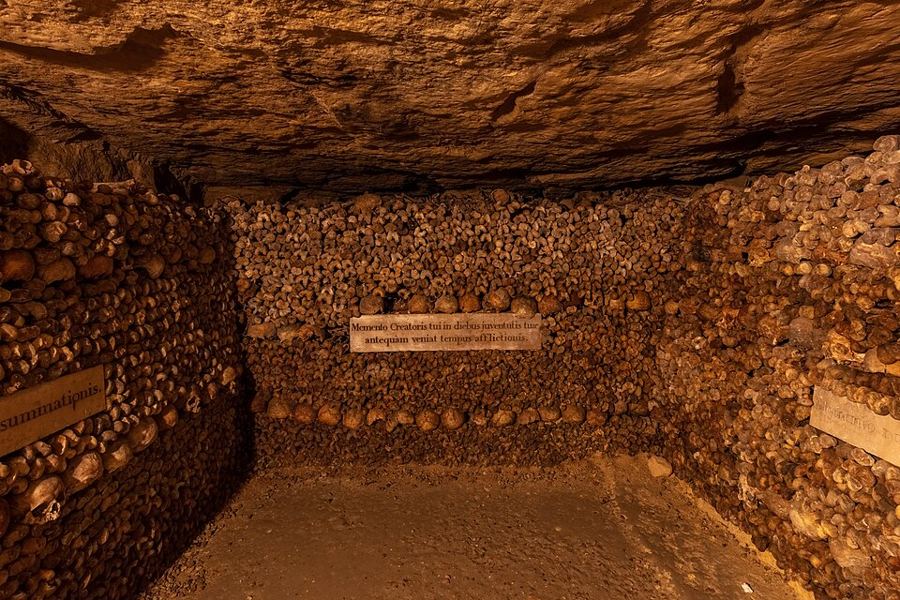
Twenty metres beneath the 14th arrondissement of Paris lie the bones of around six million Parisians, stacked into walls of skulls and thigh bones in old limestone quarries. The Paris Catacombs were not built as a tomb. They were the answer to two separate crises: a city whose cemeteries had become a public health disaster, and a city that was literally falling into the holes it had dug beneath itself.
A city built on holes
Much of Paris was built from limestone dug out from under the city and its outskirts. According to the official Catacombs site, the Tombe-Issoire quarries under the plain of Montrouge were in use from at least the 15th century and then abandoned. They were a small part of a labyrinth that eventually extended under the city over roughly 800 hectares.
As Paris grew, it spread over its own abandoned mines. Major ground collapses in the mid-18th century led Louis XVI to found the General Quarry Inspection on 4 April 1777, with the job of consolidating the old quarries before more streets and houses disappeared into them.
A cemetery full to bursting
At the same time, the city's cemeteries were overflowing. The worst was Saints-Innocents, the largest cemetery in Paris, which according to the official history had been in continuous use for nearly ten centuries. In 1815 Héricart de Thury described it as a 'frightful centre of putrefaction' kept going for more than ten consecutive centuries by every generation of Parisians, in a passage quoted by the art historian Guini-Skliar.
Saints-Innocents was closed in 1780. Wikipedia's account says the final crisis came when a basement wall in a property next to the cemetery collapsed under the weight of the mass grave behind it. The authorities decided to empty the city's cemeteries into the old quarries, then outside the capital, and chose the Tombe-Issoire site because it was easy to reach.
Bones by night
Preparation of the quarries and the organisation of the transfers were entrusted to Charles-Axel Guillaumot, an inspector of the quarry service, who carried out a quick first adaptation of the quarries in 1786: clearing backfill, building new support pillars and roughly restructuring the space.
The first evacuations, from 1785 to 1787, emptied Saints-Innocents. The tombs, common graves and charnel house were cleared of bones, which, the official history says, were carried at night to avoid hostile reactions from Parisians and the Church. The bones were dumped down two quarry wells and then spread and piled through the galleries by quarry workers.
On 7 April 1786 the site was blessed and consecrated as the Paris Municipal Ossuary. From then on it took the name 'Catacombs', after the Roman catacombs that fascinated the public at the time. Transfers continued after the Revolution until 1814, as parish cemeteries in the centre of Paris such as Saint-Eustache and Saint-Nicolas-des-Champs were suppressed. They began again in 1840 and during Haussmann's rebuilding of Paris around 1859 to 1860, the last transfers.
Walls of skulls
For its first decades the ossuary was a disorganised dump of bones. That changed under Louis-Étienne Héricart de Thury, Guillaumot's successor as inspector of quarries, who rearranged it from about 1810. According to the official site, he wanted to give the dead a dignified resting place and took a museum-like, monumental approach.
The bones were stacked in the walls that visitors see today: a facade of rows of femurs and tibias alternating with lines of skulls, with the rest of the bones piled behind. Many of these are only fragments, broken when they were tipped into the quarry. Héricart de Thury added masonry monuments in Antique and Egyptian styles, Doric columns, altars and tombs, and named areas such as the Sepulchral Lamp and the Samaritan Fountain. He installed plaques with religious and poetic texts and built two cabinets of curiosities, one of minerals and one of bone diseases and deformities.
Tourists underground
From 1809 the Catacombs were open to the public by appointment, and they quickly became a success. The official history records royal visitors in the 19th century, including Napoleon III, who went down with his son in 1860. Today the visit covers about 1.5 kilometres, with 131 steps down and 112 back up, at a depth of about 20 metres.
The lost doorkeeper
The most famous story of the tunnels is that of Philibert Aspairt, a doorkeeper at the Val-de-Grâce hospital. According to the story, he went into the quarries in 1793 and lost his way. His body was found 11 years later, in 1804, in one of the quarry galleries, reportedly a short distance from an exit, and may have been identified by the hospital key ring on his belt. He was buried where he was found. His tomb is in a restricted part of the old quarries, not the public ossuary.
How much of the detail is true is hard to say. The tomb is real, but the documents disagree: his surname is spelled differently, the tomb gives a burial date of 30 April 1804 while the death certificate is dated 8 May 1804, and he is described both as a doorkeeper and as a quarryman. Why he went underground, and how he died, come from later retellings, so his story is best read as part legend.
Myths and what really happened
People often call the whole network of tunnels under Paris 'the Catacombs'. As the official site points out, this is a shift in meaning: strictly, the Catacombs are only the part of the old quarries turned into an ossuary in the 18th century, while the wider network is a separate labyrinth of former quarries, much of it closed to the public. The often-quoted figure of six million dead is an estimate, but it is the one used by the museum and by historians.
Legacy
The ossuary is now one of the museums of the City of Paris. Few places show so plainly how a city's past, quite literally, lies beneath it.
Further reading
As posted on X: read the Stranger Than History thread