Oktoberfest Began as a Royal Wedding
October 12, 1810
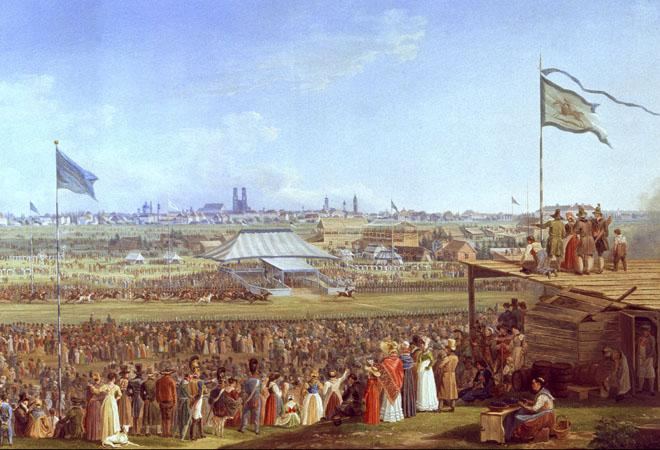
The world's most famous beer festival did not start with beer. It started with a wedding. In October 1810 Munich threw a five-day public party for its crown prince and his bride, and finished it with a horse race on a meadow outside the city gates. People liked it so much that they did it again the next year, and the year after that.
A royal wedding
Bavaria had only become a kingdom four years earlier, in 1806. On 12 October 1810 its crown prince, Ludwig, who later reigned as King Ludwig I, married Princess Therese of Saxe-Hildburghausen. According to the City of Munich's official history and Britannica, the official celebrations lasted five days.
The festivities in the city centre were already being called a folk festival. Children in traditional Bavarian costume greeted the royal family with poems, flowers and produce from the countryside.
A horse race on a meadow
The idea for the festival's grand finale is credited by the city to Andreas Michael Dall'Armi, a banker and major in the Bavarian National Guard, who proposed celebrating the wedding with a big horse race; King Max I Joseph approved. Wikipedia notes that a coachman, Franz Baumgartner, later claimed credit for the idea, but it was Dall'Armi whom Munich honoured, awarding him its first gold citizens' medal in 1824 for 'inventing' the Oktoberfest, according to the city.
The race took place on 17 October 1810 on open grassland outside the gates of Munich. The meadow was named 'Theresens-Wiese', Therese's meadow, in honour of the bride. It is still called the Theresienwiese, and locals still call the festival simply 'die Wiesn'. As the city's history points out, there were no beer tents or fairground rides at that first event.
Doing it again
The race was such a success that it was repeated at the same time the following year, which is how the tradition of the 'October festival' began. In 1811, Britannica and the city both note, the race was combined with an agricultural fair to promote Bavarian farming. A version of that fair, the Bavarian Central Agricultural Festival, is still held every few years on part of the grounds during Oktoberfest.
The festival quickly grew. In 1818, according to the city, the first carousel and two swings appeared; Britannica dates the first food and drink booths to the same year. In 1819 Munich's city authorities took over the festival and decided it should be held every year. The horse race, the oldest part of the event, finally disappeared after 1938.
From beer stalls to beer tents
Beer came gradually. In the early decades small booths sold beer, and in 1825 the authorities limited the number of beer sellers. The giant beer halls that define the modern festival came much later: the city dates the first large beer halls, built by innkeepers working with breweries, to the mid-to-late 1890s, and by 1907 the small stalls had been replaced by festival halls belonging to Munich's big breweries.
Only beer from Munich's traditional breweries that meets the city's purity rules may be served. According to the city's regulations, those are currently Augustiner, Hacker-Pschorr, Löwenbräu, Paulaner, Spaten and the state-owned Hofbräuhaus.
Cancelled festivals and a dark day
Oktoberfest has not always gone ahead. The city counts 26 cancellations since 1810, mostly because of wars, but also because of cholera epidemics in the 19th century, inflation in 1923 and 1924, and most recently the COVID-19 pandemic in 2020 and 2021. The very first cancellation came in 1813, during the Napoleonic Wars.
The festival's darkest moment came on the evening of 26 September 1980, when a bomb exploded near the main entrance. Thirteen people were killed, including the bomber, a right-wing extremist, and more than 200 were injured. A memorial now stands near the entrance, and a commemoration is held every year.
Myths and what really happened
Many people assume Oktoberfest was always a beer festival, or that it is named after a festival held entirely in October. In fact it began as a wedding celebration with a horse race, and the beer halls came nearly a century later. Today most of the festival actually takes place in September. The founding date, 12 October 1810, is not in doubt.
Legacy
Since records began in 1980, the city says, between five and seven million people have visited every year, making it the largest folk festival in the world; Britannica puts the figure at more than six million. Cities around the world now hold their own Oktoberfests. All of them trace back to a royal wedding and a horse race on a meadow named after a princess.
Further reading
As posted on X: read the Stranger Than History thread
Sources
- https://en.wikipedia.org/wiki/Oktoberfest
- https://www.oktoberfest.de/en/magazine/tradition/the-history-of-oktoberfest
- https://stadt.muenchen.de/dam/jcr:acc9595b-4675-471e-bfba-35cf2dd7569a/oktoberfest-munich-history.pdf
- https://www.britannica.com/topic/Oktoberfest
- https://en.wikipedia.org/wiki/Oktoberfest_bombing