Tarrare, the Man Who Ate Everything
c. 1798
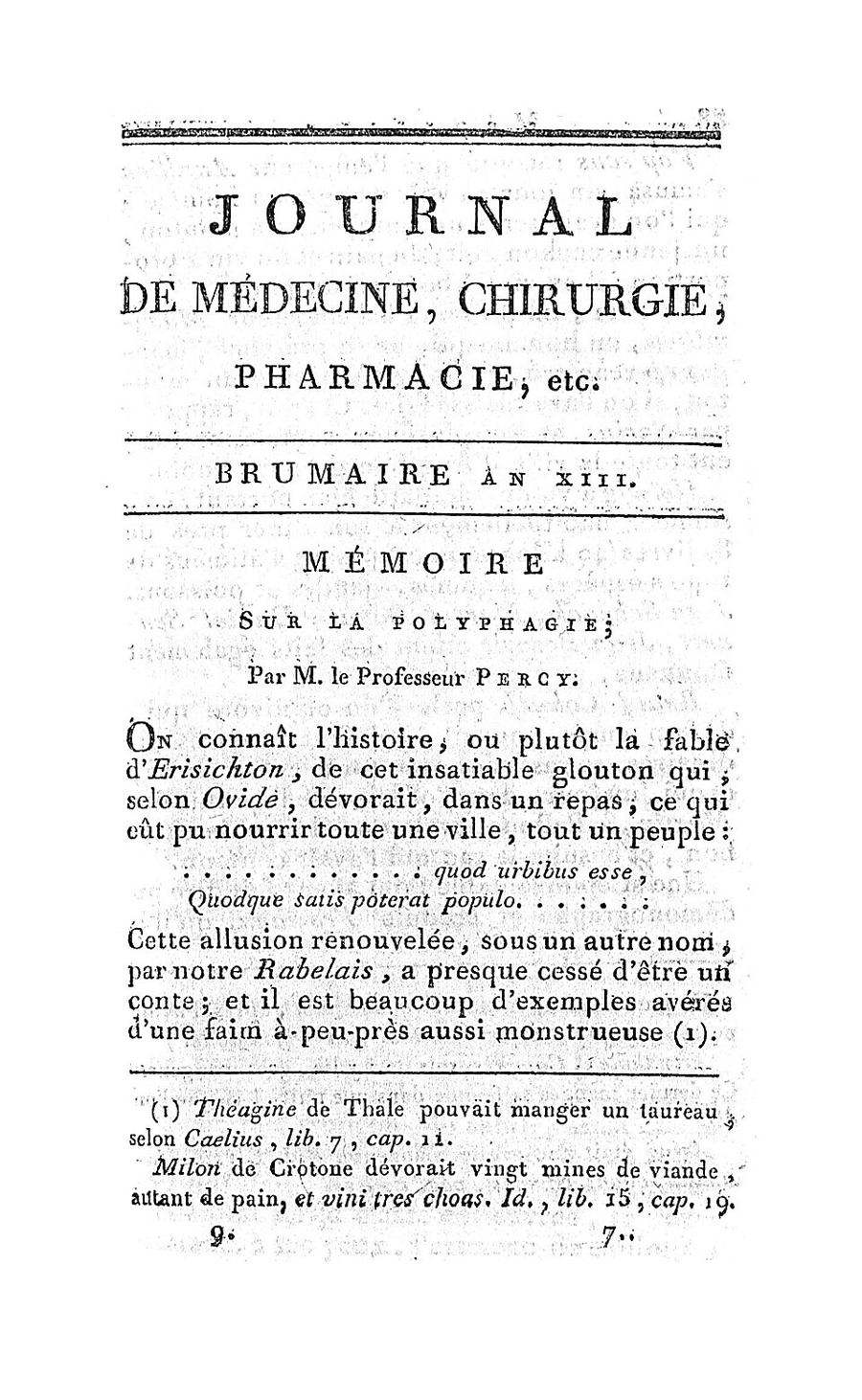
In the 1790s a thin, sickly-looking young Frenchman called Tarrare became a medical puzzle. He was constantly hungry, could eat astonishing quantities of food, and swallowed things no one should swallow. Military surgeons studied him, the army sent him on a spy mission, and his doctor wrote up his case in a medical paper that is still the main source for his life.
A boy who could not be fed
According to Wikipedia and a research summary from Bath Spa University, Tarrare was born near Lyon around 1772 and was turned out of his family home as a teenager because his parents could not satisfy his hunger. Both sources say he travelled France with a band of thieves and prostitutes and became the warm-up act for a travelling charlatan, swallowing corks and stones to amaze crowds. The Bath Spa summary says he took his act to Paris in 1788, aged about 16.
The soldier with a bottomless stomach
When France went to war in the early 1790s, Tarrare joined the Revolutionary Army. Army rations were nowhere near enough. Both sources say he ended up in a military hospital at Soultz in Alsace (the sources differ on which of the region's two Soultz towns), where the surgeon-in-chief, Pierre-François Percy, took an interest in him. Wikipedia says Percy and another surgeon, Courville, ran tests of his eating capacity. Wikipedia, drawing on Percy's account, says these included a meal meant for 15 people in one sitting, and live animals; these claims come from Percy's paper and are best read as his record rather than independently confirmed facts.
A swallowed message
The army found an unusual use for him. Both sources describe a plan to have Tarrare carry military documents by swallowing them in a box and passing them later. On his first mission, they say, he was sent across Prussian lines, captured almost at once, beaten and subjected to a mock execution, then returned to the French side. Wikipedia adds that the message he carried was not actually important.
Darker rumours
Back in hospital, Percy tried to cure him, without success. Both sources say Tarrare was caught trying to drink the blood of patients being bled and sneaking into the morgue. When a 14-month-old child disappeared from the hospital, he was suspected and forced to leave. No one ever proved he was responsible, and it is important to say so: the accusation rests on suspicion recorded in Percy's account.
The golden fork
Some four years later, according to both sources, Percy was told that a bedridden patient at Versailles wanted to see him. It was Tarrare, who believed a golden fork he had swallowed two years earlier was killing him. Percy diagnosed advanced tuberculosis, and Tarrare died shortly afterwards. The Bath Spa summary says no fork was found at the autopsy. Wikipedia says the autopsy found an abnormally wide gullet, so wide that surgeons could see down into his stomach.
Myth versus reality
Tarrare's story sounds like a legend, and some details may have grown in the telling. Almost everything we know comes from one man, Percy, writing years after the events. So the safest summary is that Tarrare was a real patient with an extreme appetite whom Percy documented in detail, while the most lurid episodes should be taken as Percy's account. Modern doctors have suggested possible medical explanations, but with no living patient to examine, his condition remains unexplained.