The 1561 Sky Battle over Nuremberg
April 14, 1561
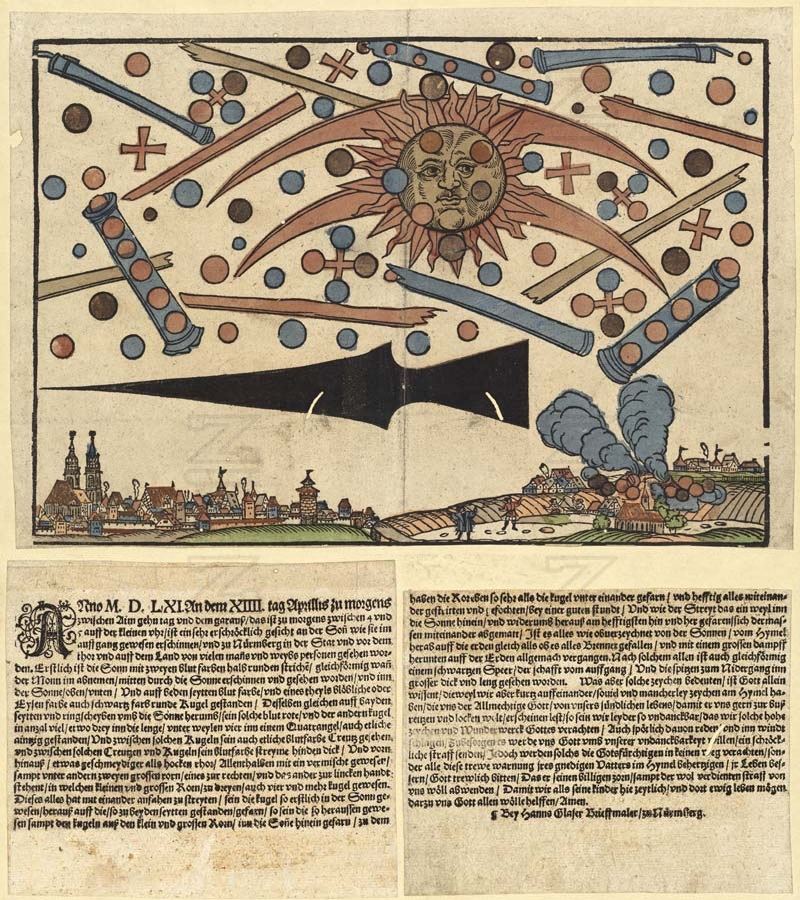
At dawn on 14 April 1561, according to a printed news sheet published in Nuremberg that month, many men and women saw a terrifying spectacle around the rising sun: blood-red arcs, black and red globes, crosses and rods that seemed to fight one another for more than an hour before falling to earth in smoke. The broadsheet's vivid woodcut has become one of the most reproduced images in UFO literature. Historians and scientists read it very differently.
What people reported
Everything we know about the event comes from one broadsheet, a single printed sheet with a large woodcut and a text, sold to the public. It was printed in Nuremberg in 1561 by Hans Glaser, who signs himself a 'Brieffmaler', a letter-painter or printer of popular prints. The Zentralbibliothek Zürich, which holds the surviving copy in the collection assembled by the Zurich clergyman Johann Jakob Wick, describes it as a coloured woodcut with printed text, about 26 by 38 centimetres.
The text says that at daybreak on 14 April 1561, between four and five o'clock, a 'dreadful apparition' appeared on the sun and was seen in Nuremberg, in the city, before the gates and in the country, by many men and women. First, in the middle of the sun, there were two blood-red semicircular arcs, like the moon in its last quarter. Around the sun stood balls of a dull, partly black, iron colour, and many blood-red balls, some three in a line, some four in a square, some alone. Between them were blood-red crosses and blood-red strips like reed rods, among them two big rods, with three, four or more globes in them.
Then, the text says, they began to fight. Globes flew out of the sun to those around it, and back in again, and fought vehemently for over an hour. When the conflict was most intense they grew tired, fell from the sun to the earth 'as if they all burned', and wasted away with a great smoke. Finally something like a long, thick black spear was seen, its shaft pointing east and its point west.
Glaser did not claim to know what it meant. 'Whatever such signs mean, God alone knows,' the text says, and it goes on to urge readers to treat such signs as warnings from God and to repent. The woodcut shows all of these elements at once over a landscape, with smoke rising from the ground.
What investigators found
The modern UFO interpretation is recent. According to the author Jason Colavito, as summarised on Wikipedia, the image became widely known outside Germany after the psychologist Carl Jung reproduced it in his 1958 book on flying saucers. Jung himself thought it was most likely a natural phenomenon, seen through the religious and military imagery familiar to 16th-century Europeans. Ufologists have since cited it as evidence of a battle between spacecraft, while the UFO researcher Jacques Vallée was sceptical, noting how closely it resembles other celestial-wonder broadsheets of the period.
Atmospheric scientists point to a halo display. Speaking to the German public broadcaster Deutschlandfunk on the event's 460th anniversary, Claudia Hinz, chair of the German halo and meteor observers' association Arbeitskreis Meteore, explained that halos are caused by sunlight passing through ice crystals, usually in thin, icy clouds eight to ten kilometres up. They can produce rings and arcs around the sun, coloured spots and bright 'mock suns', or sun dogs, beside it, more than 50 different forms in all. They are a purely optical effect, she noted, and have nothing to do with fire. The arcs, coloured globes and crosses in Glaser's text fit this kind of display, and the 'falling' and 'smoke' may describe the halo fading or clouds moving at sunrise.
Hinz also warned against reading the woodcut as a photograph. Broadsheets of this period were usually not drawn by the observers: they were commissioned, and the artist painted what he himself read into the account, or packed everything seen that day into one picture. That makes it hard today to say exactly what was seen. The woodcut, for example, shows the black spear at the same time as the earlier globes and crosses, although the text says it appeared only after everything else.
Glaser printed other sheets of the same kind, recording strange signs in the sky in 1554 and 1556 and another Nuremberg sky sign in March 1561, all now held in Zurich. Such broadsheets were a popular genre, combining news, wonder and a call to repentance. What the people of Nuremberg actually saw on 14 April 1561 cannot be recovered exactly, but the evidence points to a spectacular natural display of light, interpreted in the religious language of the age.
Further reading
- Deutschlandfunk: Vor 460 Jahren, beängstigendes Himmelsspektakel über Nürnberg (German)
- Zentralbibliothek Zürich catalogue record of the broadsheet