The Great Airship Wave of 1896-97
November 17, 1896
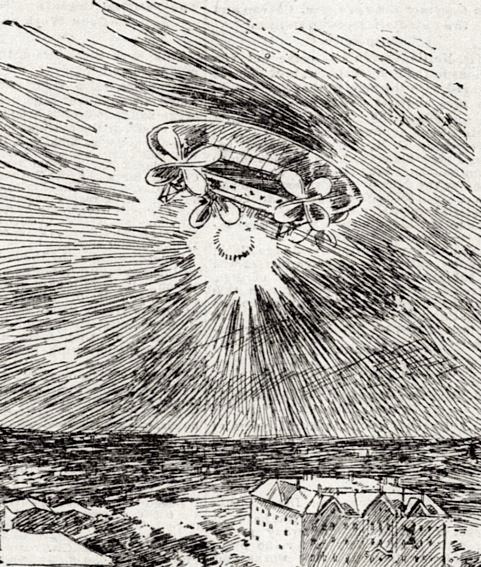
Between November 1896 and May 1897, thousands of Americans from California to the Midwest and Texas reported seeing an airship: a cigar-shaped craft with wings or propellers and a bright searchlight, gliding through the night sky. Some said they had talked to its crew. All this happened years before the Wright brothers' first flight in 1903, at a time when no practical airship existed.
What people reported
The wave began in Sacramento, California. As the sociologist Robert Bartholomew recounts in Skeptical Inquirer, on 17 November 1896 the Sacramento Bee printed a telegram from a New York man claiming that he and two friends would board an airship of his invention and fly to California within two days. That same night, hundreds of people in Sacramento reported seeing an airship.
Sightings spread through California and the Pacific coast until mid-December, then died away. A second, larger wave began in late January 1897 and moved eastward across the country until early May. Bartholomew cites a collection of more than 1,000 newspaper stories about the airship, and gives a conservative estimate of 100,000 individual sightings, since some reports involved whole towns turning out to watch. According to the researcher Thomas Bullard, whom he cites, roughly 80 to 90 per cent of sightings were at night.
Witnesses generally agreed on the look of the thing. The Texas Almanac, describing the Texas sightings of April 1897, says the airships were typically described as having cigar-shaped bodies or cabins 50 to 60 feet long, propellers at each end, large bat-like wings and huge floodlights fore and aft. Between 13 and 17 April 1897 alone, it notes, there were 38 reported sightings in 23 Texas counties.
Some reports went further. Unlike modern alien encounters, Bartholomew notes, the occupants witnesses claimed to have talked to usually appeared to be ordinary Americans, inventors about to revolutionise travel. The Dallas Morning News correspondent at Waxahachie reported a long conversation between a local judge and an airship crew who said they were from the North Pole. At Greenville, a correspondent was told the ship was being test-flown across the country by an inventor from New York state. In Farmersville, a witness said he saw three men in the cabin singing 'Nearer My God to Thee'. The most famous story of all, the airship crash at Aurora, Texas, appeared on 19 April 1897.
What investigators found
Aviation historians are clear that whatever people saw, it was not a working airship. Bartholomew quotes the British aviation historian Charles Gibbs-Smith, a specialist in the period before 1910, who said that the only passenger-carrying aircraft that could have been seen anywhere in North America at the time were free-flying spherical balloons; no dirigible or heavier-than-air machine was flying, or could fly. The Wright brothers did not fly until 1903.
The newspapers themselves played a central role. This was the era of 'yellow journalism', and many stories were speculative or simply invented. William Randolph Hearst's San Francisco Examiner attacked rival papers in an editorial in December 1896, calling the airship story 'pure myth' and the product of 'fake journalism'. Some of the Texas dispatches, the Texas Almanac notes, read as tongue-in-cheek, and Texans seem to have competed to outdo one another: two farmers in Hill County reported a man and six boys floating down from the sky. Even at the time, a doctor in Ennis put the sightings down to 'hypnotism and bad whiskey'.
Bartholomew argues the wave was a case of collective wish-fulfilment. Americans of the 1890s were fascinated by invention. Magazines and dime novels were full of flying machines, inventors were filing airship patents in secret, and many people believed a practical airship was about to be unveiled. Experimental craft were in the news: in September 1896 the New York Times reported the crash of an experimental airship called the Albatross. In this atmosphere, a bright star or planet, a balloon, or a light behind a moving cloud could easily become 'the airship'. The waves also followed the newspaper stories: the 1896 sightings clustered in California, where the inventor was supposed to be flying, and the 1897 wave moved eastward as papers predicted a transcontinental flight.
No inventor ever came forward with a working machine, and the sightings ended almost as suddenly as they began. The airship wave is now seen as a forerunner of the flying saucer reports of the 20th century: a lesson in how expectation, ambiguous lights and an excitable press can produce thousands of sincere sightings of something that was not there.
Further reading
- Robert E. Bartholomew, Skeptical Inquirer (1990): The Airship Hysteria of 1896-97
- Texas Almanac: When airships invaded Texas