The Halifax Explosion
December 6, 1917
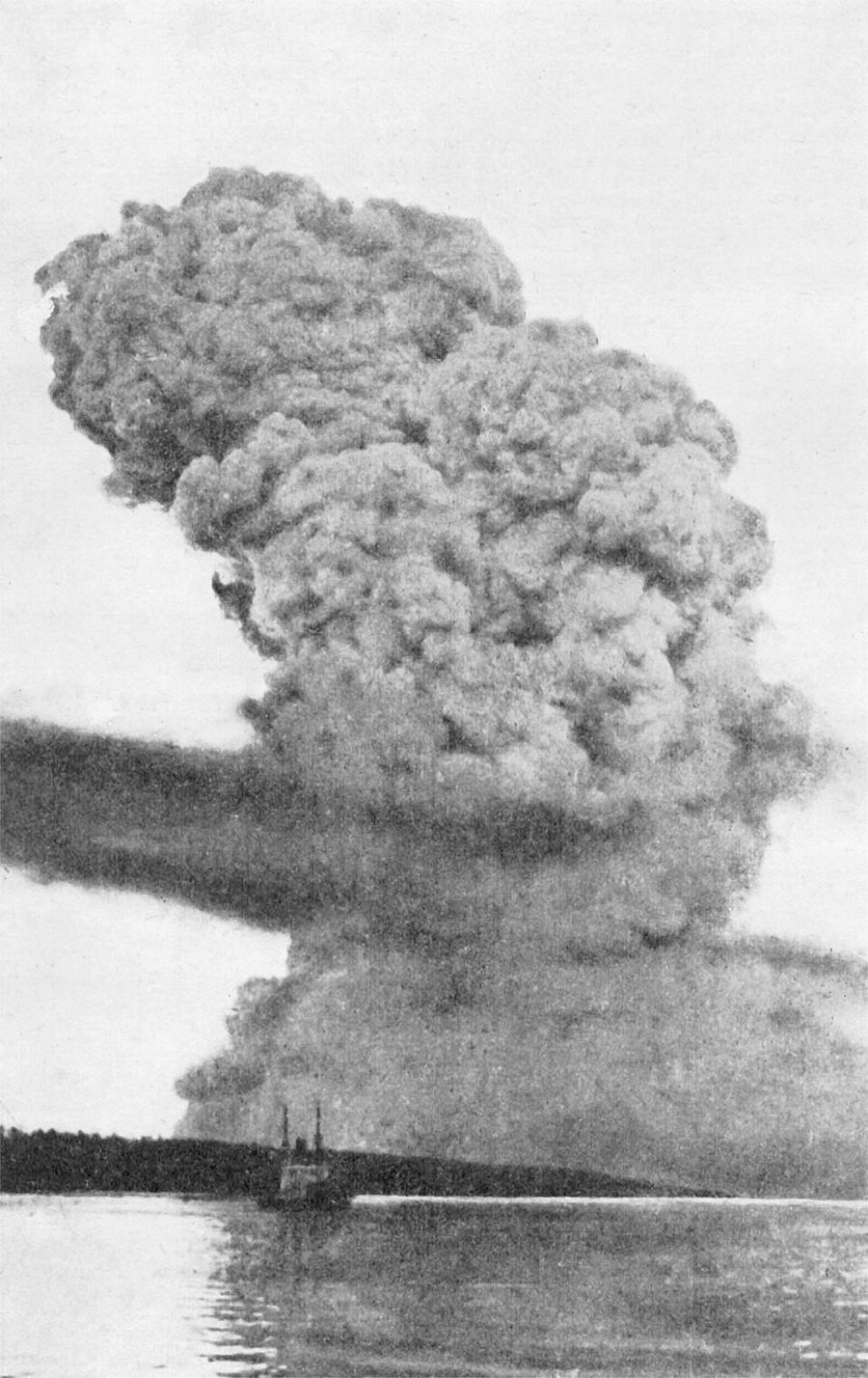
On the morning of 6 December 1917, in the Narrows of Halifax Harbour, the French munitions ship Mont-Blanc collided with the Norwegian freighter Imo. Fire took hold among barrels of benzol on Mont-Blanc’s deck. About twenty minutes later the ship vanished in a blast that levelled the Richmond district, threw Imo onto the Dartmouth shore, and killed roughly eighteen hundred people. Until the atomic bombs of 1945 it was the largest human-made explosion the world had seen.
A wartime harbour
By late 1917 Halifax was one of North America’s busiest convoy ports. Merchant ships gathered in Bedford Basin behind anti-submarine nets before sailing for Britain and France. The Maritime Museum of the Atlantic notes that Mont-Blanc was inbound from the Atlantic with war material for France, while Imo was outbound from Bedford Basin for New York to load relief supplies for occupied Belgium. Wikipedia, drawing on the same wartime context, places the harbour at the centre of Canadian and Allied Atlantic shipping.
Mont-Blanc’s cargo was the disaster waiting to happen: picric acid, TNT, guncotton and benzol. Ships with that kind of load had once been kept out of the inner harbour; wartime submarine risk had loosened the rules. Both vessels needed to pass through the Narrows, a tight channel where traffic was supposed to keep to the starboard side and stay within a low speed limit.
Collision, fire, crowd
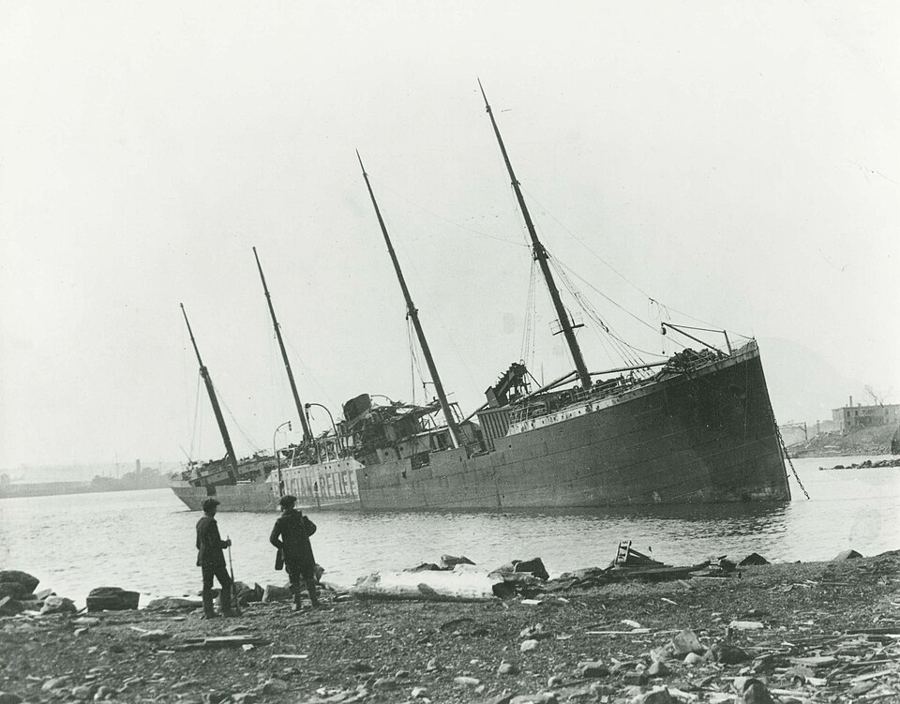
On the morning of the 6th the two ships met in a confusion of whistle signals. Imo had been delayed overnight and was pushing through the Narrows; Mont-Blanc, under harbour pilot Francis Mackey, was heading in. Wikipedia’s reconstruction, built from the inquiry record and later histories, has them exchanging conflicting blasts, cutting engines too late, and meeting at low speed around 8:45 a.m. Imo’s bow struck Mont-Blanc’s starboard side.
The hull damage alone was not catastrophic. Benzol barrels on deck ruptured, vapours filled the hold, and sparks as the ships pulled apart set the ship on fire. Mont-Blanc’s crew abandoned her and rowed for the Dartmouth shore, shouting warnings that few ashore could hear. The burning ship drifted toward Pier 6. People in Richmond and along the waterfront gathered at windows and on the docks to watch the spectacular fire, a detail McAlister and colleagues emphasise in their British Journal of Ophthalmology study of the eye injuries that followed.
Nine o’clock
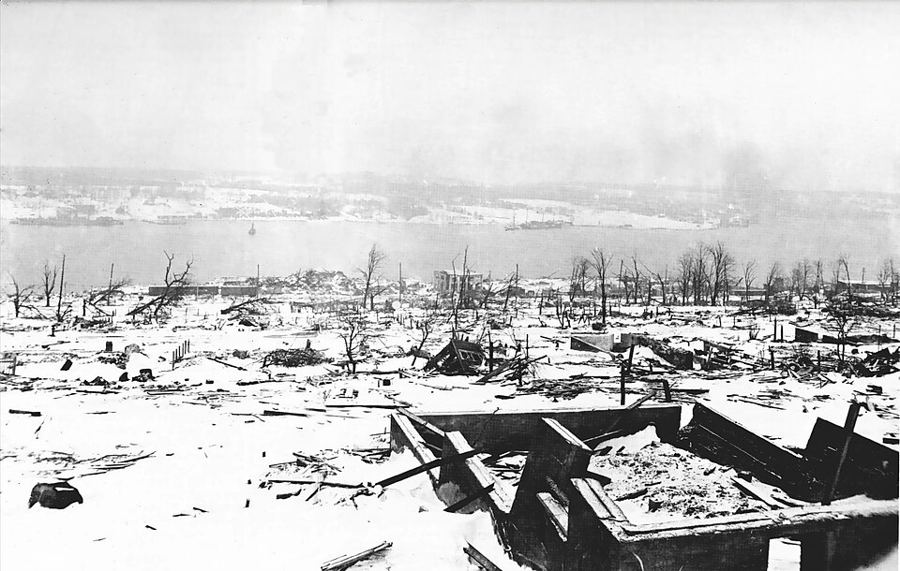
At about 9:04 or 9:05 a.m. the fire reached Mont-Blanc’s main cargo. Sources differ by a few seconds on the exact clock time: Wikipedia, citing technical reconstructions, gives 9:04:35; the Maritime Museum’s Coleman narrative rounds to 9:05. The ship was destroyed. A blast wave flattened buildings across Richmond, a tsunami swept the shoreline, and fragments of the hull fell kilometres away. The Maritime Museum describes a rising cloud of hot gas, oily chemical rain, and devastation across an eight-kilometre scatter of debris. Energy-release estimates commonly put the explosion near 2.9 kilotons of TNT, and both the museum and Wikipedia treat it as a roughly three-kiloton event in a crowded modern port.
Imo was hurled onto the Dartmouth shore. Almost every structure within a few hundred metres of Pier 6 was obliterated. Fires started from overturned stoves across the North End. Across the harbour, Dartmouth was damaged and the Mi’kmaw settlement at Turtle Grove was wiped out by blast and wave; the Maritime Museum and Wikipedia both record that community among the hardest hit.
The strangest and cruellest details
Hundreds of the wounded were people who had simply been looking. Double-paned winter windows turned into shrapnel. McAlister and colleagues, reviewing archival medical records, report that twelve ophthalmologists treated 592 people with eye injuries and performed 249 enucleations; sixteen people lost both eyes. The same paper notes that glass shards caused most of those injuries, and that sympathetic ophthalmia was still a feared reason for removing a damaged eye in 1917.
Railway dispatcher Vincent Coleman became the disaster’s best-known individual story. Working in a wooden station only a few hundred feet from Pier 6, he learned the burning ship was full of munitions, started to flee, then went back to his key. The Maritime Museum quotes one of the reported wordings: hold up the train, munitions ship on fire and making for Pier 6, goodbye boys. Newspapers printed slight variations. Whether his message alone stopped the overnight passenger train from Saint John is debated in the museum’s own account; what is clear is that the warning raced along the Intercolonial line and sped the dispatch of relief trains from across Nova Scotia and New Brunswick that same day. Coleman was killed at his post.
Myth versus inquiry
Many survivors first thought the Germans had attacked from sea or air. That rumour faded as the collision story emerged, though the Halifax Herald and others kept suspicion alive for a time, and a Norwegian helmsman was briefly arrested as a suspected spy when a letter in Norwegian was mistaken for German.
Blame was fiercely contested. An early wreck inquiry pinned responsibility on Mont-Blanc’s captain, her pilot and the naval examining officer. Appeals later held both ships at fault for navigational errors. No one was successfully convicted for causing the disaster. Another myth is that a precise single death toll is known: the Nova Scotia Archives Remembrance Book lists 1,782 confirmed victims, the Maritime Museum says more than 1,700, and some medical summaries of the period speak of roughly 2,000 dead. About 9,000 injured appears across those same sources. We keep the Remembrance Book figure as the confirmed count and treat higher round numbers as estimates.
Aftermath
A blizzard the next day dumped heavy snow on the ruins, stalled some incoming relief and knocked repaired telegraph lines down again, while also helping smother fires. Help still came: Maritime Museum and Wikipedia both record relief trains from the Maritimes on the day itself, with further aid from central Canada and the northeastern United States, including a major response from Boston.
Reconstruction reshaped the North End. Temporary housing went up through the Halifax Relief Commission; the Hydrostone district of fireproof concrete-block homes became the emblem of planned rebuilding. Africville, the Black community on Bedford Basin, received far less of that progressive reconstruction. Memorials now mark Fort Needham and other sites, and the Maritime Museum keeps a permanent exhibition on the explosion, including Coleman’s telegraph key and watch. The blast remained a yardstick for large explosions until Hiroshima; Time magazine, comparing the 1945 bomb, still measured its power against Halifax.
Further reading
- Maritime Museum of the Atlantic: Explosion in The Narrows
- Maritime Museum: Vincent Coleman and the Halifax Explosion
- McAlister et al., British Journal of Ophthalmology (2007)
- Nova Scotia Archives: Halifax Explosion Remembrance Book
Sources
- https://en.wikipedia.org/wiki/Halifax_Explosion
- https://www.thecanadianencyclopedia.ca/en/article/halifax-explosion
- https://maritimemuseum.novascotia.ca/stories/explosion-narrows-1917-halifax-harbour-explosion
- https://maritimemuseum.novascotia.ca/stories/vincent-coleman-and-halifax-explosion
- https://doi.org/10.1136/bjo.2006.113878
- https://thecanadianencyclopedia.ca/en/article/halifax-explosion