The Cottingley Fairies
1917
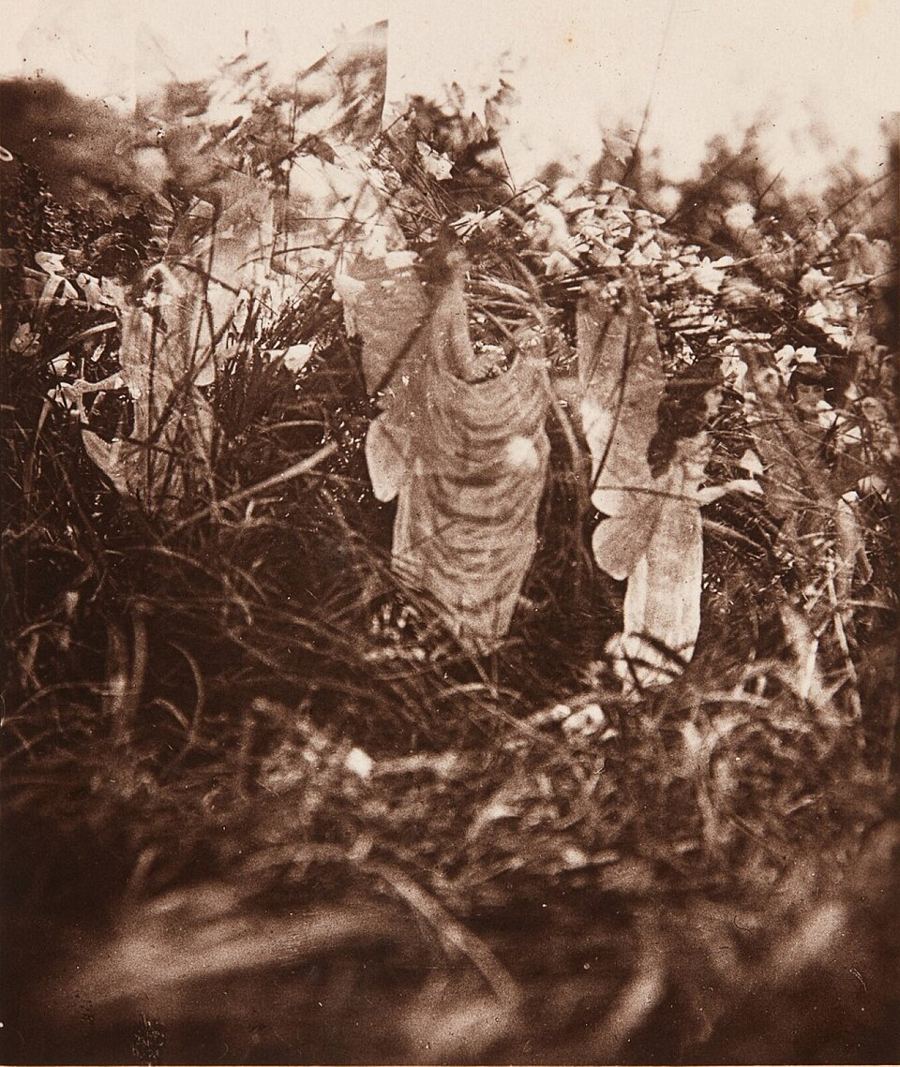
In 1917 two young cousins in the Yorkshire village of Cottingley borrowed a camera and came back with photographs of fairies dancing at the bottom of the garden. Three years later Sir Arthur Conan Doyle, the creator of Sherlock Holmes, presented the pictures to the world as genuine. It took more than six decades for the cousins to admit how they had done it.
Two cousins and a camera
In 1917 Frances Griffiths was living with her cousin Elsie Wright's family in Cottingley, near Bradford. Elsie was 16; Frances was 9 according to most accounts (the University of Leeds, which holds a Cottingley Fairies collection, gives her age as 10). The girls liked to play by the beck, the stream at the bottom of the garden, and said they saw fairies there.
To prove it, they borrowed Elsie's father's camera. When he developed the plate, it showed Frances behind a group of small winged figures. Arthur Wright dismissed them as cardboard cut-outs. After a second photograph, showing Elsie with a gnome-like figure, he refused to lend the girls his camera again.
How it was done
Elsie was artistic. A man whose mother went to school with her told the BBC that she 'used to draw fairies all over her exercise book'. In a letter now in the Science Museum Group collection, Elsie later explained that she had copied fairy drawings onto card. The figures were based on illustrations in Princess Mary's Gift Book, a popular children's book of 1914.
In a later television interview, Elsie explained the method: the fairies were paper cut-outs held in place with hatpins. 'At that time women wore great big pinwheel hats,' she said, 'and they had to take hat pins about this long.'
The theosophists and Conan Doyle
The photographs might have stayed a family joke. But in 1919 Elsie's mother attended a meeting of the Theosophical Society, a movement interested in spiritualism and the supernatural, and mentioned them. The prints reached Edward Gardner, a leading theosophist, who took them up enthusiastically.
Arthur Conan Doyle heard about them while preparing an article on fairies for the Strand Magazine. Conan Doyle was a committed spiritualist. In the Science Museum letter, Elsie later suggested that he had recently lost his son in the war and was 'trying to comfort himself'. In the Christmas 1920 issue of the Strand, he published the photographs and declared them authentic.
Were the experts fooled?
Gardner had the original plates examined. A photography expert, Harold Snelling, declared them unfaked, meaning they had not been doctored in the darkroom, which was true: the fakery was in front of the lens. Kodak found no obvious signs of faking but would not certify the pictures as genuine. Another firm, Ilford, reported some evidence of faking. Gardner and Doyle, perhaps optimistically, counted the three expert verdicts as two in favour and one against.
More photographs
In July 1920, with Doyle about to leave on a lecture tour of Australia, Gardner went to Cottingley himself. Elsie's father told him he had been so sure the pictures were fake that he had searched the girls' bedroom and the area around the beck for scraps or cut-outs, and found nothing. Gardner gave the girls two cameras and secretly marked plates, and the cousins produced three more fairy photographs. Gardner sent an ecstatic telegram to Doyle, by then in Melbourne. Doyle hoped that if the public accepted fairies, they might more readily accept other psychic phenomena. Critics noted that the fairies looked strikingly like fashionable illustrations of the day, with modern hairstyles. Early press coverage was mixed. One London paper, Truth, commented in January 1921 that what was needed to explain the photographs was not a knowledge of the occult but a knowledge of children. Still, many people believed, and the story divided opinion for decades.
Confession
In 1983 the cousins admitted in an article in the magazine The Unexplained that the photographs had been faked, though both still said they had really seen fairies. According to the Science Museum letter, the cousins had decided to wait until the people who had believed them died of old age before telling the truth. 'We will wait till they die of old age and then we will tell,' she wrote.
But they disagreed about the fifth photograph: Elsie said it was faked like the others, while Frances insisted it was genuine, and each claimed to have taken it. The University of Leeds notes that Frances held to this until the end of her life, and Colin Harding of Bradford's National Science and Media Museum told the BBC that some mystery remained.
Myths and what really happened
It is often said that Conan Doyle 'proved' the fairies were real, or that scientists authenticated them. In fact the expert reports were mixed, and the key test only showed the plates had not been retouched. The bigger lesson, as many writers have noted, is how readily even clever people believe photographs that confirm what they want to be true.
Legacy
Arthur Wright's camera later went to the National Science and Media Museum in Bradford. The story has inspired films, including FairyTale: A True Story and Photographing Fairies (both 1997), and villagers recalled that Cottingley was nicknamed 'Fairyland', with bus conductors calling out the name at the stop. Archives at the University of Leeds and the Science Museum Group keep the photographs, letters and cameras that tell the story.
Further reading
As posted on X: read the Stranger Than History thread
Sources
- https://en.wikipedia.org/wiki/Cottingley_Fairies
- https://www.bbc.co.uk/bradford/content/articles/2008/04/25/cottingley_fairies_feature.shtml
- https://explore.library.leeds.ac.uk/special-collections-explore/8705
- https://collection.sciencemuseumgroup.org.uk/objects/co469870
- https://blog.scienceandmediamuseum.org.uk/the-story-of-the-cottingley-fairies-shows-that-image-manipulation-is-nothing-new/