The Tunguska Event
June 30, 1908
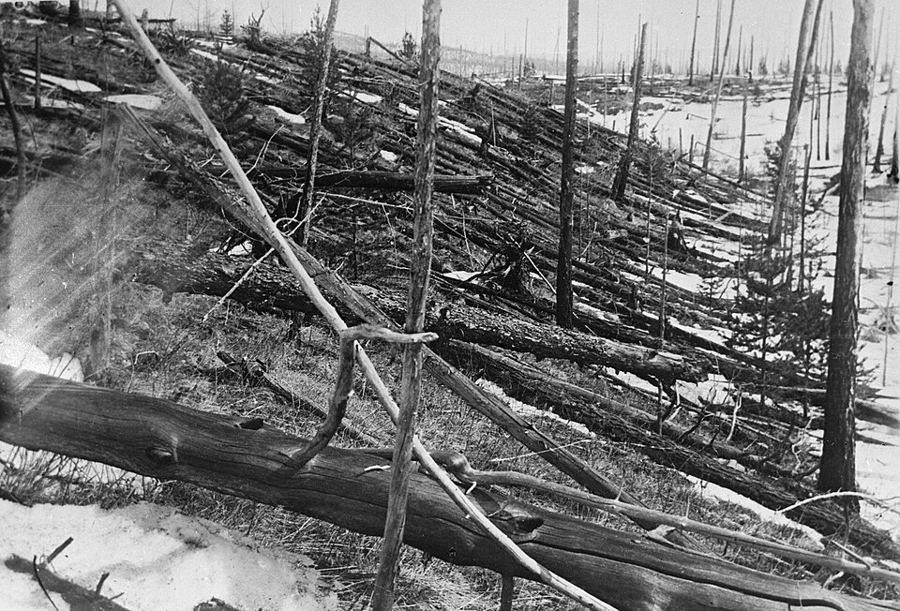
Early on the morning of 30 June 1908, a fireball crossed the sky over central Siberia and exploded above the forest near the Podkamennaya Tunguska River. Trees went down across an area larger than many cities, and yet, when scientists finally reached the spot, there was no crater. More than a century later, scientists still use it to understand what a modest space rock can do.
A remote corner of Siberia
The blast happened in one of the emptiest parts of the Russian Empire, a region of taiga forest and rivers home to Evenki herders and a few small trading settlements. According to Wikipedia the nearest, Vanavara, lay about 60 km south of the epicentre. That remoteness is the main reason the blast is not remembered as a mass-casualty disaster.
The morning of the blast
NASA's history office dates the event to about 7:15 am local time on 30 June 1908. Witnesses described a bolide that, Wikipedia says, some judged brighter and larger than the Sun, followed by a flash, heat and booms. NASA's Earth Observatory says the object, estimated at 50 to 100 metres across, exploded roughly 6 to 10 km above the ground, vaporising almost entirely, injuring eyewitnesses and toppling and scorching trees across hundreds of square kilometres.
Both NASA articles describe it as an airburst: the object broke apart in the air rather than striking the ground in one piece, which is why the destruction spread outward from a point in the sky.
Strange lights and standing trees
Some of the oddest evidence was seen far away. Wikipedia records that for several nights after the blast the skies over much of western Eurasia stayed unusually bright.
At the site, trees were laid flat in a radial pattern, pointing away from the centre, but near the epicentre NASA notes that some were left standing, stripped of branches and bark like telegraph poles, which is what you would expect from a blast directly overhead.
Twenty years before anyone looked
No scientific expedition reached the area for nearly two decades. NASA puts this down to the remoteness of the region and to the First World War, the Russian Revolution and the civil war that followed. The mineralogist Leonid Kulik led expeditions in the 1920s and 1930s; both NASA sources and Wikipedia say his teams documented the felled and scorched trees in a radial pattern, and Wikipedia says he reached the epicentre in 1927. There was no crater to find.
Myths and wild theories
The missing crater invited speculation. Wikipedia lists ideas ranging from a micro black hole to an alien spacecraft, mostly in fiction, plus an urban legend that Nikola Tesla caused it with a 'death ray', which it says the historical record contradicts. The serious debate was comet versus asteroid; NASA says most scientists today believe it was an asteroid.
Numbers grow in the retelling too. A popular claim says 80 million trees fell; Wikipedia lists it under erroneous statements traced to a loose early estimate. Energy estimates also vary widely, from 3 to 30 megatons of TNT according to Wikipedia, so we do not give a single figure.
Why it still matters
Tunguska is the reference case for how dangerous a modest space rock can be. NASA's history article ties it to planetary defence and notes that in 2016 the United Nations proclaimed 30 June International Asteroid Day. The much smaller 2013 Chelyabinsk airburst over Russia, which NASA puts at about 500 kilotons, showed such events are not just history.
Further reading
- NASA History: 115 years ago, the Tunguska asteroid impact event
- NASA Earth Observatory: A cosmic explosion over Siberia