The Great Molasses Flood
January 15, 1919
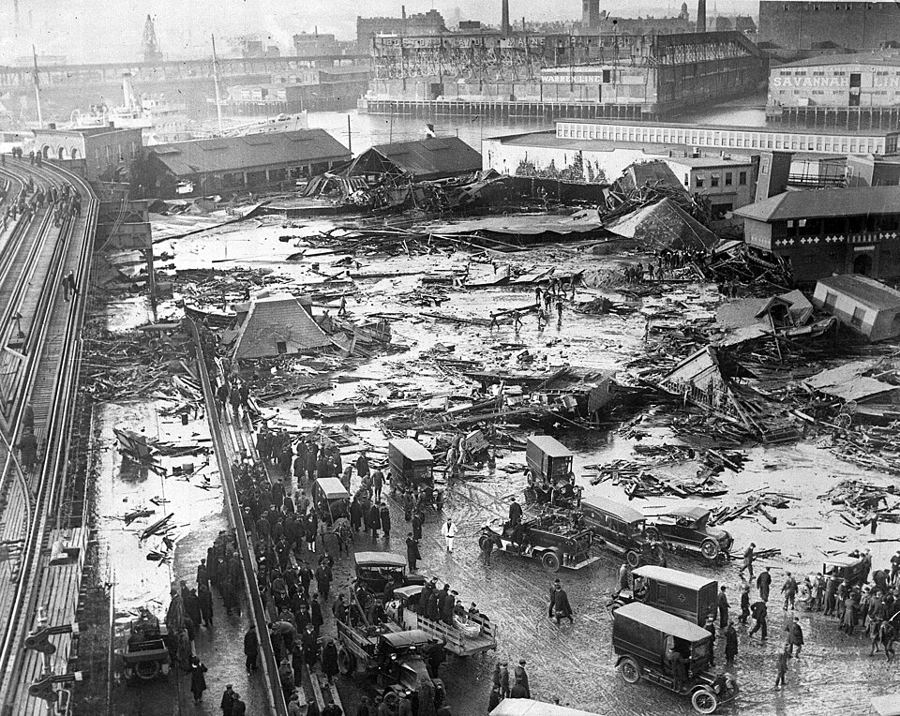
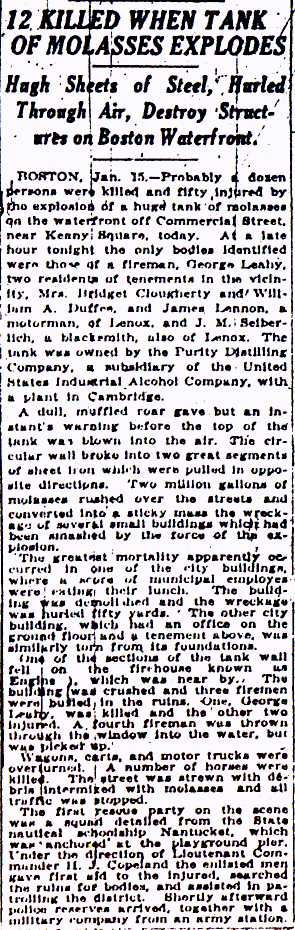
Shortly after lunchtime on 15 January 1919, a storage tank on Boston's waterfront tore apart and released more than two million gallons of molasses into one of the city's busiest neighbourhoods. Within minutes 21 people were dead and around 150 injured. It sounds like a joke. It was one of the deadliest industrial accidents in the city's history.
A tank nobody trusted
In 1915 the Purity Distilling Company, part of United States Industrial Alcohol, put up a huge steel tank on Commercial Street beside Boston Harbor. Molasses arrived by ship from the Caribbean and was stored there before being taken to a distillery to be turned into industrial alcohol, a product in heavy demand during the First World War for making munitions.
The tank was about 50 feet tall and could hold well over two million gallons. HISTORY describes its construction as rushed and haphazard, and it leaked from the start. According to the City of Boston's own account, which draws on Stephen Puleo's history of the disaster, locals could see molasses seeping from the seams, North End children collected pails of it, and when people complained, Purity Distilling painted the tank brown to hide the oozing. HISTORY reports that at least one employee warned his bosses the tank was unsound, but beyond re-caulking it, little was done.
The North End was a crowded, mostly Italian immigrant neighbourhood, packed with homes, warehouses, a fire station and the girders of an elevated railway that ran along Commercial Street.
Noon on a warm January day
15 January 1919 was unusually mild for a Boston winter. People were out in the street, workers were taking their lunch, and children were playing nearby. The tank had recently been topped up with a new shipment.
At about 12:40 p.m., according to 1919 accounts, the tank split apart. The Boston Post later described 'a rumble, a hiss, some say a boom and a swish' as the wave swept out. Contemporary accounts estimated the first wave at about 25 feet (7.6 metres) high, though some later writers give a lower figure, so the exact height is uncertain. It moved at more than 15 metres per second, over 30 miles per hour.
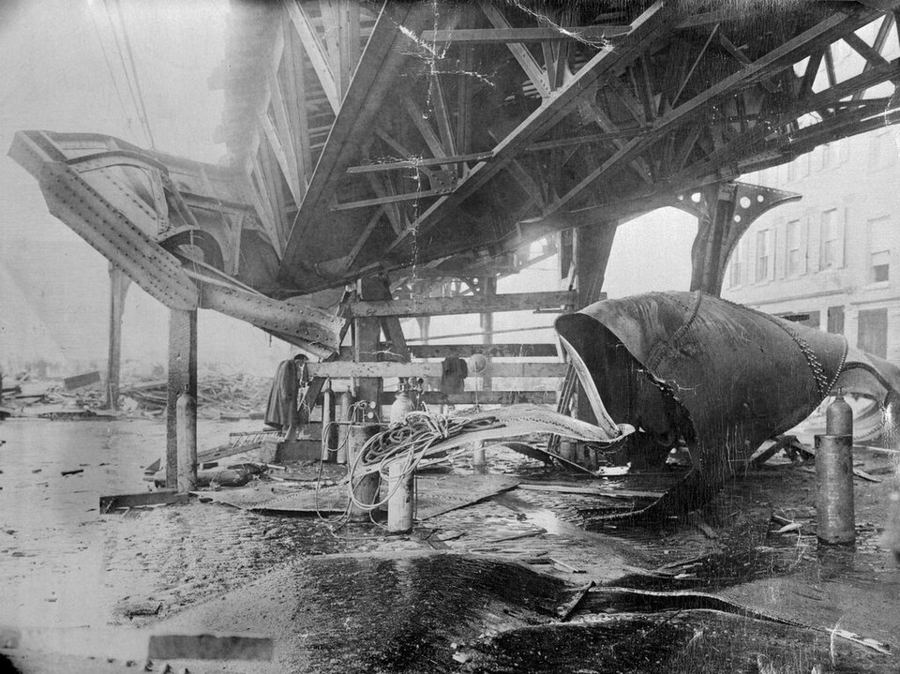
The wave crushed buildings, damaged the elevated railway structure along Commercial Street and suffocated people and animals caught in its path. It moved a firehouse off its foundation; at the Engine 31 firehouse, firefighters had been eating lunch and playing cards when the wave hit.
Why molasses was so deadly
Molasses is not just sticky; it is thick, and it gets thicker as it cools. In 2016 Nicole Sharp and Jordan Kennedy, working with Harvard physicist Shmuel Rubinstein and his students, presented a study to the American Physical Society that modelled the flood. Their work suggests that the molasses spread out fast while it was still relatively warm from the tank, then thickened sharply as it cooled in the January air.
That combination was cruel. The initial wave was fast and heavy enough to destroy buildings, and then the syrup set into something like quicksand. People caught in it could not pull themselves out, and rescuers struggled to reach them. The search went on for four days, and some bodies were recovered from the harbour months later.
The rescue
First on the scene were 116 cadets from the USS Nantucket, a training ship of the Massachusetts Nautical School docked nearby. Police, Red Cross nurses, and Army and Navy personnel soon followed. In places the molasses was knee-deep. Rescuers struggled through the syrup, which had already begun to stiffen in the cold, pulling out survivors and searching for the trapped.
The final toll was 21 people dead and about 150 injured. Cleaning up was a struggle: molasses coated everything and made wreckage almost impossible to move. City workers eventually found that salt water broke it down, and they sprayed the area with water pumped from the harbour, with help from the Engine 31 fireboat. More than 300 workers joined the clean-up in the following days, and HISTORY reports that the sweet smell hung over the North End for months.
The victims
According to the City of Boston, most of those killed were labourers and drivers working at the North End Paving Yard and on Copps Hill Wharf, right beside the tank. The youngest victims were 10-year-old children: Pasquale Iantosca and Maria Distasio, who had been out enjoying the unusually warm weather.
Telling the story through the victims matters. The flood is often treated as a quirky footnote because of the substance involved, but the people it killed were ordinary workers and children from a working-class immigrant neighbourhood, and their families waited years for compensation.
Myths and what really happened
The company's first explanation was sabotage. United States Industrial Alcohol argued that anarchists had bombed the tank, a claim that fitted the fears of the time but for which no real evidence emerged.
A popular story says the molasses wave hit at 35 mph; the physics study supports a speed of more than 15 metres per second, which is roughly the same, so the figure is reasonable. The company's claim that the tank was bombed was taken seriously at the time because Italian anarchist groups had been blamed for a string of bombings across the country, according to HISTORY. The legal inquiry ultimately rejected it. Beyond the months-long smell that HISTORY describes, residents reported smelling molasses on hot days for decades.
Aftermath and legacy
Survivors and families sued, and their claims were combined into a single huge legal proceeding. HISTORY describes it as running for years, with some 1,000 witnesses, including explosives experts, survivors and company employees, and more than 1,500 exhibits; the closing arguments alone took 11 weeks.
After three years of hearings, court-appointed auditor Hugh W. Ogden rejected the sabotage claim and found the company responsible. Structural engineers had reported that the tank's walls were far too thin for the load. It paid about $628,000 in damages, roughly $7,000 per victim's family.
A historical marker now stands near the site, and the flood has become a fixture of Boston history, revisited on its centenary in 2019 and still studied by physicists for what it reveals about how thick fluids behave.
Further reading
- City of Boston: 100 years ago today, molasses crashes through the North End
- APS News: the physics of the molasses flood (2017)
Watch the Short
Sources
- https://en.wikipedia.org/wiki/Great_Molasses_Flood
- https://www.massmoments.org/moment-details/molasses-flood-in-boston.html
- https://meetings.aps.org/Meeting/DFD16/Session/L27.8
- https://www.aps.org/archives/publications/apsnews/201701/physicshistory.cfm
- https://www.theguardian.com/science/2017/feb/25/study-reveals-why-so-many-met-a-sticky-end-in-bostons-great-molasses-flood
- https://www.boston.gov/news/100-years-ago-today-molasses-crashes-through-bostons-north-end
- https://www.history.com/articles/the-great-molasses-flood-of-1919