Franz Reichelt, the Flying Tailor
February 4, 1912
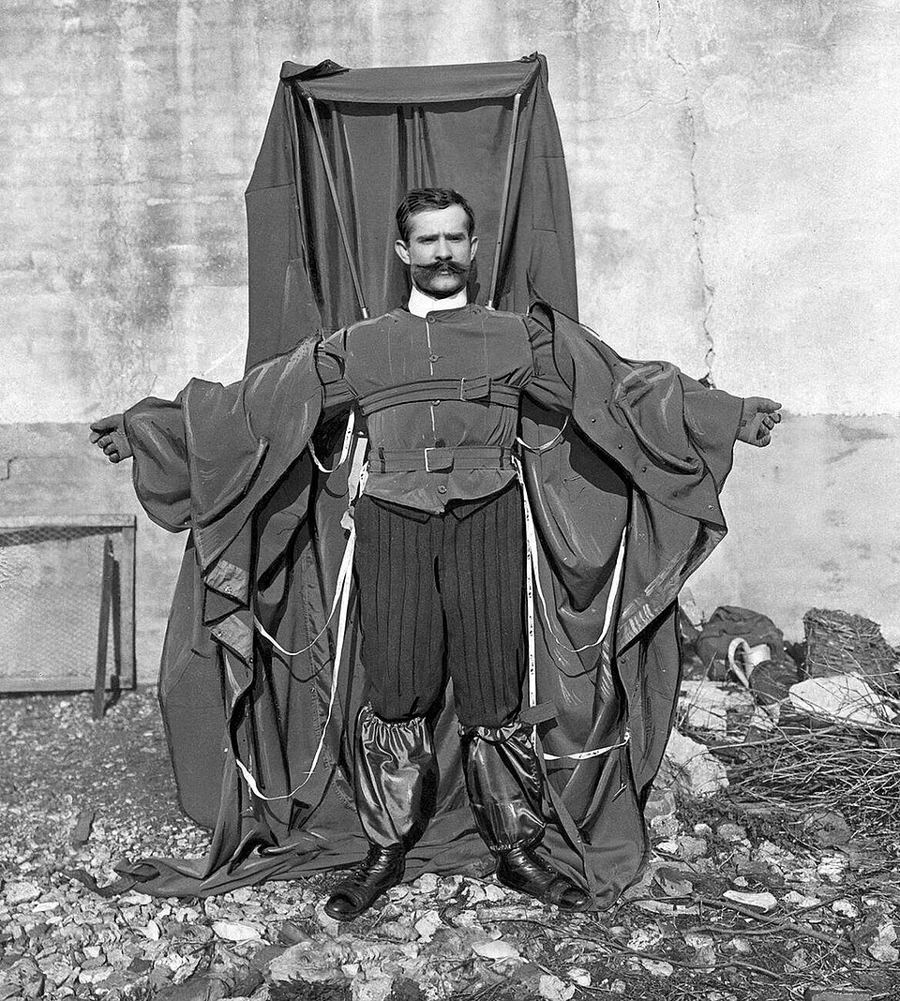
On a freezing morning in February 1912, a tailor named Franz Reichelt climbed onto the railing of the Eiffel Tower's first platform wearing a suit he had designed himself, a wearable parachute. He had told the authorities he would test it with a dummy. Instead he jumped himself, in front of newsreel cameras.
The flying tailor
Franz Reichelt was born in the Austrian Empire and moved to Paris, where he became a successful tailor. Like many people in the early years of powered flight, he was fascinated by the danger pilots faced. Aircraft were fragile, crashes were common, and there was no practical parachute for pilots. A prize had been offered for a safety parachute for aviators, and Reichelt set out to win it.
His idea was a suit that a pilot could wear normally and that would open into a canopy of silk if needed. Early test versions, dropped with dummies from the fifth floor of his building, reportedly worked well enough. As he tried to make the suit lighter and more practical to wear, the results got worse.
Why the Eiffel Tower
Reichelt became convinced that his failures were caused by insufficient height: from a few storeys up, the canopy did not have time to open. He applied for permission to test from the Eiffel Tower. According to reports, the police finally agreed, believing that he would throw a dummy.
The morning of the jump
On 4 February 1912 Reichelt arrived at the tower with friends, and reporters and newsreel cameramen gathered. He then announced that he would jump himself. Friends tried to talk him out of it, and a guard is reported to have tried to stop him. Reichelt insisted he was confident, reportedly telling them he would 'see you soon'.
He climbed to the first platform, about 57 metres up. Accounts say he stood on a stool on a restaurant table to get over the railing, tested the wind, then hesitated for around 40 seconds. Then he jumped.
The fall
The suit did not open into a canopy. It folded around him and he fell almost straight down, striking the frozen ground at the base of the tower. Contemporary reports said the impact left a shallow hole about 15 centimetres deep. He was killed. The cameras filmed the whole sequence, and the footage still survives in newsreel archives such as British Pathé. It is often described as one of the earliest deaths ever caught on film, though that kind of claim is hard to prove definitively.
The suit
Accounts of the suit differ, which is not surprising for a homemade prototype that changed many times. According to Le Point, early versions used foldable wings, and the leading aviation body, French aviation authorities, turned the design down as too heavy and cumbersome; Atlas Obscura cites Le Matin's report that they warned him the surface was too weak and he would break his neck. In 1911 the Aéro-Club offered 10,000 francs for an effective aviator's parachute weighing under 25 kilograms, and Reichelt reworked his design to chase it. The New York Times reported in 1912 that the suit he wore was made of khaki-coloured canvas.
His dummy tests kept failing; Le Point says the dummy fell 'with the grace of a flat iron', and that by some reports Reichelt had already hurt himself in smaller trial jumps, including breaking a leg at Nogent-sur-Marne. Reichelt seems to have been certain that a greater height would let the canopy open. The evidence of his own experiments pointed the other way.
A crowd at the tower
Reichelt had made sure his test would be seen. Reporters and photographers came, and newsreel cameramen set up to film from the ground and from the platform. That publicity is the reason we know so much about the morning, and also the reason it became so well known so quickly: the film was shown in cinemas and the story ran in newspapers across Europe and beyond.
The New York Times reported that his permit from the Prefecture stipulated a dummy, but that there was little secrecy that he meant to jump himself, in 10 degrees of frost and a stiff wind. According to the same report, the death prompted protests that evening against allowing such a test again.
Myths and details
Some retellings say a later medical examination found that Reichelt died of a heart attack before he hit the ground. That claim comes from a single source and is not established, so we leave it as unconfirmed. Figures for the size of the suit's canopy also vary between accounts.
What is clear is that he had been warned, that he believed in his invention, and that he chose to test it himself rather than with a dummy.
Legacy
Reichelt's death was widely reported and became a famous cautionary tale about overconfidence. Practical parachutes did develop over the following years, along different lines, and the Eiffel Tower itself remembers him among the many daredevils who have performed stunts there. The film of his jump remains a haunting piece of early cinema history.
Further reading
- British Pathé archive: 'Death Jump - Eiffel Tower' (1912 film)
- Eiffel Tower official site: daredevils of the tower
As posted on X: read the Stranger Than History thread
Sources
- https://en.wikipedia.org/wiki/Franz_Reichelt
- https://www.iflscience.com/franz-reichelt-and-the-eiffel-tower-wingsuit-incident-of-1912-79555
- https://www.britishpathe.com/asset/92596/
- https://www.atlasobscura.com/articles/flying-tailor-eiffel-paris-france-parachute
- https://www.lepoint.fr/culture/4-fevrier-1912-il-s-elance-de-la-tour-eiffel-deguise-en-oiseau-et-s-ecrase-comme-un-enclume-03-02-2012-1427327_3.php
- https://fr.wikisource.org/wiki/Le_Saut_dans_la_mort
- https://timesmachine.nytimes.com/timesmachine/1912/02/05/100348074.pdf
- https://www.toureiffel.paris/en/news/history-and-culture/tower-inspires-amazing-feats