Theodore Roosevelt Shot Mid-Campaign
October 14, 1912
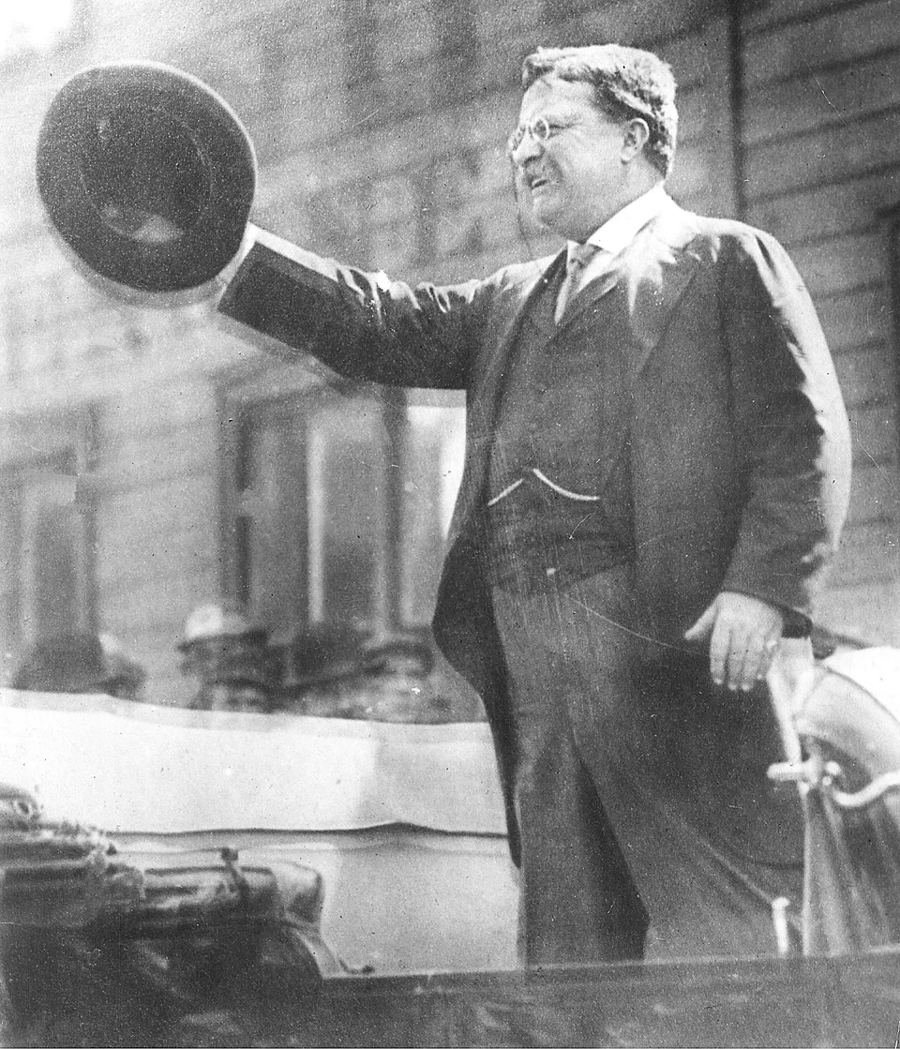
On the evening of 14 October 1912, former president Theodore Roosevelt was shot in the chest outside a hotel in Milwaukee. He did not go to hospital. He went to the auditorium where he was due to speak and talked to the crowd for well over an hour with the bullet still in him.
The Bull Moose campaign
Roosevelt had been president from 1901 to 1909. In 1912, unhappy with his successor William Howard Taft, he tried to win the Republican nomination back, failed, and ran instead for the new Progressive Party, nicknamed the Bull Moose Party after he said he felt 'as strong as a bull moose'. It was a hard-fought, three-way race against Taft and the Democrat Woodrow Wilson, and Roosevelt was travelling the country giving speeches.
The shot
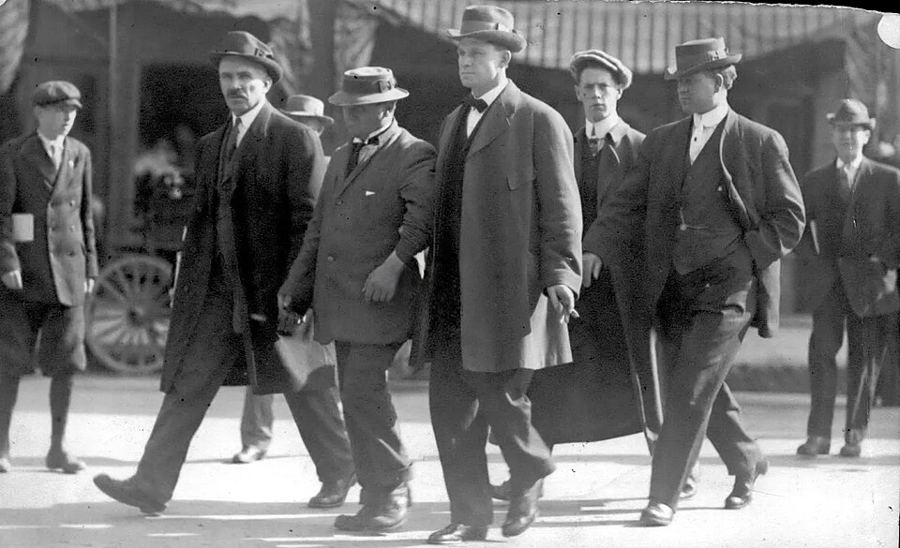
In Milwaukee, Roosevelt left the Hotel Gilpatrick to get into an open car that would take him to the city auditorium. As he stood to wave to the crowd, a man named John Schrank shot him with a revolver from a few feet away.
Schrank was a former saloonkeeper from New York who had been following Roosevelt's campaign. He later claimed that the ghost of the assassinated president William McKinley had appeared to him in a dream and told him to avenge his death by killing Roosevelt, whom he also opposed for seeking a third term. Bystanders seized him, and Roosevelt is reported to have told them not to hurt him.
Saved by a speech
The bullet hit Roosevelt in the right side of the chest, but on its way it passed through a steel spectacles case and a thick, folded copy of his speech, about 50 pages long, in his coat pocket. These slowed it down. It lodged against a rib rather than reaching his lung.
Roosevelt, an experienced hunter with some knowledge of anatomy, coughed into his hand and saw no blood, and concluded the wound was not fatal. He refused to go to hospital and insisted on giving the speech.
'It takes more than that to kill a Bull Moose'
At the auditorium he told the audience: 'I don't know whether you fully understand that I have just been shot; but it takes more than that to kill a Bull Moose.' He showed them his bloodstained shirt and the speech with the bullet holes through it.
He then spoke for well over an hour. Accounts of the exact length differ; the Smithsonian's account of the event describes him speaking for about 80 minutes, and other sources say close to 90. Only afterwards did he go to hospital.
The bullet stays
X-rays showed the bullet lodged in the chest muscle. Doctors decided that removing it would be more dangerous than leaving it, and Roosevelt carried it for the rest of his life. He later joked that it bothered him no more than if it were in his waistcoat pocket.
He spent about two weeks recovering, and Wilson, his main rival, is reported to have paused his own campaigning while Roosevelt recovered.
Why he kept talking
Roosevelt's decision looks reckless today, and his aides begged him to stop. But it fitted the image he had spent his life building: the sickly child who made himself strong, the Rough Rider who led a charge in Cuba, the big-game hunter. Speaking with a bullet in his chest was, among other things, a powerful political performance in the final weeks of a close race.
He did not give the full speech. He skipped parts of the text and spoke off the cuff for the rest.
There was a medical logic too. Roosevelt reasoned that if the bullet had entered his lung he would be coughing up blood, and he was not. He was right, though he was also lucky: the doctors who examined him afterwards agreed that the folded speech and the spectacles case had very probably made the difference between a flesh wound and a fatal one.
Aftermath
Schrank was examined by a panel of doctors, found insane, and committed to a state mental institution in Wisconsin, where he remained until his death in 1943. Roosevelt lost the election: Wilson won, with Roosevelt second and Taft third, still the best showing ever by a third-party candidate in a US presidential election.
The bullet-pierced speech and spectacles case survive in museum and library collections, and the story became one of the defining images of Roosevelt's tough, theatrical personality.
Further reading
As posted on X: read the Stranger Than History thread