Lord Uxbridge's Leg
June 18, 1815
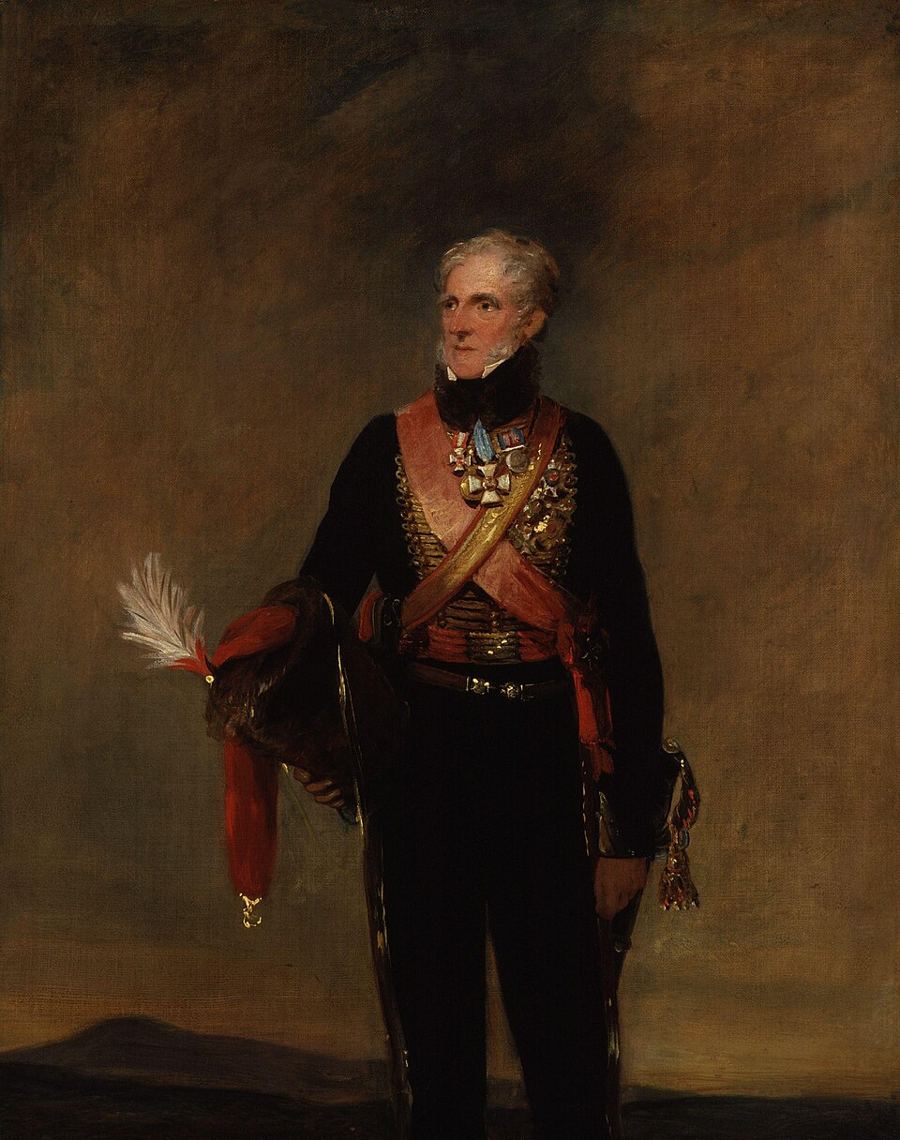
Near the end of the Battle of Waterloo on 18 June 1815, a cannon shot shattered the right leg of Lord Uxbridge, commander of the Allied cavalry. The leg was amputated in a house in the village of Waterloo. What happened to it afterwards is one of the oddest footnotes of the Napoleonic Wars: it got its own grave and tombstone, became a tourist attraction visited by royalty, caused a minor diplomatic row, and ended up in a central heating furnace more than a century later.
The cavalry commander
Henry Paget, 2nd Earl of Uxbridge, commanded 13,000 Allied cavalry and 44 guns of horse artillery at Waterloo. At about 2:30 p.m., at a critical point in the battle, he led the charge of the Household and Union heavy cavalry brigades that swept back the French infantry columns of d'Erlon's corps. His troopers then ran on out of control and were cut up by French cavalry. Uxbridge spent the rest of the day leading further charges and, according to accounts, had eight or nine horses shot from under him.
His relationship with Wellington was awkward. As the LRB blog notes, drawing on a 1961 biography by his descendant the 7th Marquess of Anglesey, Uxbridge had eloped with Wellington's sister-in-law, Lady Charlotte Wellesley.
'By God, sir'
One of the last cannon shots fired that day hit Uxbridge's right leg. The famous version of what came next has Uxbridge, riding near Wellington, exclaiming 'By God, sir, I've lost my leg!' and the Duke replying, 'By God, sir, so you have!' That exchange is an anecdote, and its wording varies.
A more reliable version may come from the diary of John Wilson Croker, a friend of Wellington, who in December 1818 recorded a conversation with Horace Seymour, the man who carried the wounded Uxbridge from the field. Seymour remembered Uxbridge crying out, 'I have got it at last,' and Wellington replying, 'No? Have you, by God?'
The amputation
Uxbridge was taken to his headquarters in the village of Waterloo, a house belonging to Hyacinthe Joseph-Marie Paris. There, with no anaesthetic, the leg was amputated above the knee by the army surgeon John Hume, with two assistants. Anaesthesia for surgery did not yet exist.
Uxbridge's composure became legendary. One anecdote has his only comment being that the knives seemed rather blunt; the LRB says he observed that the blade did not seem very sharp. According to his aide-de-camp, he said he had been a beau for 47 years and it would not be fair to cut the young men out any longer.
Afterwards he asked his fellow cavalry officer Sir Hussey Vivian to go and look at the severed limb, because some friends thought it might have been saved. Vivian examined it and reported that a grapeshot had shattered the bones to pieces, and that the leg was better off than on. The saw used in the operation is now held by the National Army Museum in London.
A grave for a leg
Monsieur Paris asked if he could bury the leg in his garden. According to the LRB, it was interred in a casket. It was given its own tombstone, with an inscription praising 'the illustrious and valiant Earl Uxbridge' and the victory that 'gloriously decided' the cause of mankind.
The grave drew visitors. Tourists were first shown the bloodstained furniture on which Uxbridge had been operated on, then taken into the garden to see the tombstone. Accounts differ on whether this was a chair or a table; the LRB says the table was kept in its blood-drenched state, and even claims that Uxbridge himself returned and insisted on dining at it. Royal visitors included the King of Prussia and the Prince of Orange. The leg, Wikipedia's account notes, provided a useful income for the Paris family for decades.
Not everyone was respectful. A wag reportedly added a couplet to the tombstone: 'Here lies the Marquis of Anglesey's limb; / The Devil will have the remainder of him.' The statesman George Canning wrote comic verses that, according to Notes and Queries, went the round of the papers.
The diplomatic incident
In 1878 Uxbridge's son visited and found the bones not in the ground but on open display. They had been exposed when a storm uprooted the willow tree beside the grave. The Belgian ambassador in London became involved, and the family asked for the leg back. The Paris family refused and offered to sell it, which, according to the LRB, the Pagets were told was the only way they would get it. The Belgian Minister of Justice ordered the bones to be reburied. Instead, they were hidden.
Into the furnace
In 1934, after the last Monsieur Paris died in Brussels, his widow found the bones in his study along with documents proving what they were. Fearing another scandal, she burned them in her central heating furnace. After 119 years above and below ground, the leg was gone.
The man and his leg
Uxbridge himself did well out of Waterloo. He refused an offered pension of £1,200 a year for the loss of his leg, and five days after the battle the Prince Regent made him Marquess of Anglesey. He wore an articulated artificial leg with a hinged knee and ankle, invented by James Potts of Chelsea; the design became known as the 'Anglesey leg'. He died in 1854.
Myths and what really happened
The 'By God, sir' exchange is the most quoted part of the story and the least certain. The bloody 'chair' versus 'table', and whether Uxbridge himself came back to dine, vary from account to account. What is well documented is the amputation, the burial and tombstone, the decades of tourism, the 1878 row and the 1934 burning.
Further reading
As posted on X: read the Stranger Than History thread