Schliemann and the Search for Troy
1873
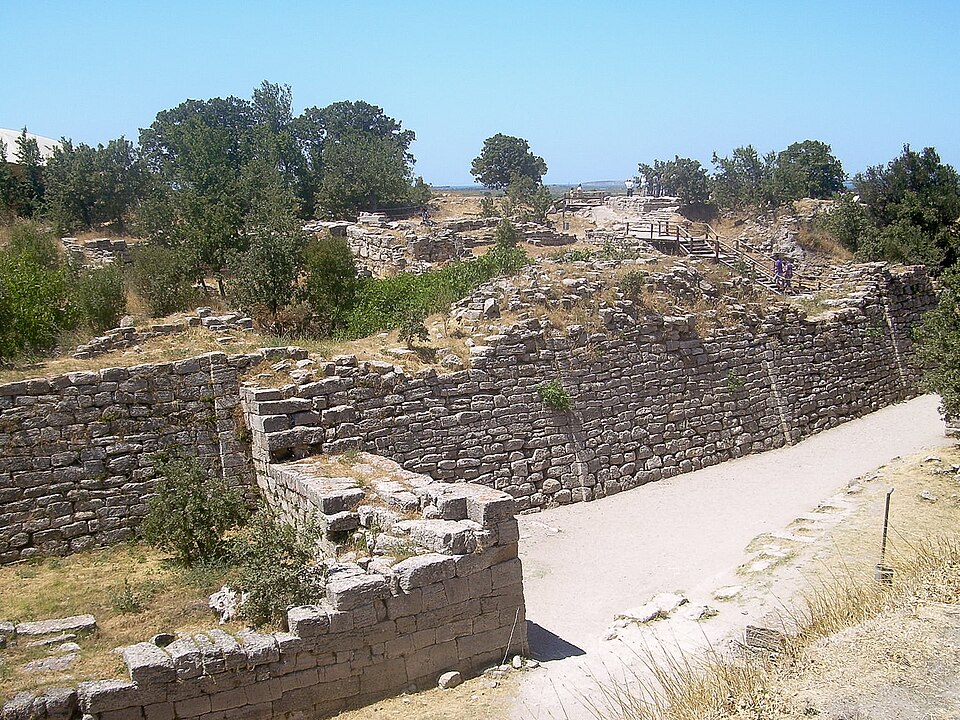
For most of history, the Trojan War was a story: the abduction of Helen, the ten-year siege, the wooden horse. Whether a real Troy ever stood behind Homer's Iliad was an open question. In the 1870s a wealthy, self-taught German businessman dug into a hill in north-west Turkey and announced that he had found it. He was partly right, partly wrong, and not nearly as alone in the discovery as he claimed.
Legend first
In Greek tradition, Troy fell to an army of Greek warriors after a long siege, the story told in Homer's Iliad and retold by later poets. UNESCO's description of the site refers to the siege by Mycenaean warriors from Greece in the 13th century BC, immortalised by Homer, and says its influence on the Iliad, Virgil's Aeneid and the arts has lasted more than two thousand years. Whether that siege happened as the poems describe is a different question, and archaeology cannot answer it directly.
What archaeology can say is that a real, important city stood at the place later Greeks and Romans called Ilion. Wikipedia notes that Hittite records refer to a city in north-west Anatolia called Wilusa, now generally identified with the site, and that in the Late Bronze Age it was a vassal of the Hittite Empire.
The man who dug
Heinrich Schliemann was born in 1822 in Mecklenburg, the son of a poor pastor, according to Britannica. He made a fortune in trade, much of it as a military contractor during the Crimean War, retired from business at 36 and threw himself into archaeology. Wikipedia likewise describes him as a German businessman before he became an archaeologist.
Schliemann later told a romantic tale: as a boy he saw a picture of Troy in flames and resolved to find it. Britannica treats that cautiously, noting that late twentieth- and twenty-first-century scholarship found a great deal of self-mythologising in how he built his reputation. Wikipedia's article is blunter, quoting historians who found that he was not good at separating fact from interpretation.
The neighbour who knew
The idea that Troy lay under the mound of Hisarlik was not Schliemann's own. Britannica says the English archaeologist Frank Calvert, who had already dug at Hisarlik, convinced him, and that Schliemann conveniently left Calvert's name out when he published the theory. Wikipedia says Calvert owned land on the mound, had excavated there in 1865 and correctly identified it with classical Ilion, and that Schliemann was at first sceptical but was persuaded.
Calvert had the knowledge; Schliemann had the money. Britannica notes that Schliemann's financial resources were much greater than Calvert's.
Digging through the cities he wanted
Schliemann began large-scale work around 1870-71. UNESCO dates his first excavations to 1870; Britannica says he took up work at the mound in 1871. Wikipedia explains the difference, describing an exploratory trench in April 1870 followed by fuller seasons.
He made one big assumption. Britannica says he believed Homer's Troy must lie at the bottom of the mound, so he dug uncritically through the upper levels. Wikipedia describes the same 'Schliemann's Trench' cut across the mound, and says his focus on the early level known as Troy II led him to overlook the later layers. Digging that fast and that deep meant cutting through the very layers that later turned out to matter most.
The mound turned out to hold not one city but many. UNESCO describes a settlement sequence of more than 3,000 years, with remains from the Bronze Age through Greek and Roman times. Wikipedia lists nine main cities, Troy I to Troy IX, later subdivided by Carl Blegen into dozens of phases.
Priam's Treasure
In 1873, Schliemann found a hoard of gold jewellery and vessels of gold, silver and bronze. Britannica says he smuggled it out of Turkey and that it became known as Priam's Treasure, after the Trojan king. Wikipedia gives the date as 15 June 1873, the day before digging was due to stop, and says Schliemann took it to be Priam's.
It was not. Britannica says the city he found proved to be older than the era he believed it to be, and that a later layer, Troy VI, was afterwards identified as the Homeric city. Wikipedia cites Calvert's view, even in 1872, that the pottery showed Troy II was far too early for the Trojan War, a point confirmed when Mycenaean pottery was found in Troy VI in 1890. It also says Schliemann privately came to agree but never published it.
The treasure had a long journey of its own. Britannica records that the Ottoman government sued Schliemann over the division of finds, delaying his return. Wikipedia says the treasure later went to Berlin, was flown to Moscow at the end of the Second World War, and is now held by the Pushkin Museum in Moscow.
Better digging, better answers
Later excavators did what Schliemann could not. Britannica credits Wilhelm Dörpfeld, who joined Schliemann in his final seasons, with bringing new rigour and exposing the stratigraphy far more clearly. Wikipedia says Dörpfeld's chief contributions were to Troy VI and VII. Carl Blegen worked there in the 1930s, and from 1988 to 2005 Manfred Korfmann's team showed that a substantial lower town spread out below the citadel. UNESCO also mentions a Lower City of about 30 hectares in the Late Bronze Age.
UNESCO inscribed Troy as a World Heritage Site in 1998 and goes so far as to call Schliemann's excavations a possible starting point of modern archaeology and its public recognition. That is a generous verdict on a flawed digger. The truer picture is a shared one: a local expert who knew where to look, a rich showman who dug fast and told a good story, and generations of archaeologists who slowly sorted out which Troy was which. The legend did not come true, exactly, but it led people to a real place with a very long history.
Further reading
- UNESCO World Heritage Centre: Archaeological Site of Troy
- Britannica: Heinrich Schliemann
- Wikipedia: Troy
- Wikipedia: Heinrich Schliemann