Knossos and the Minotaur
1900
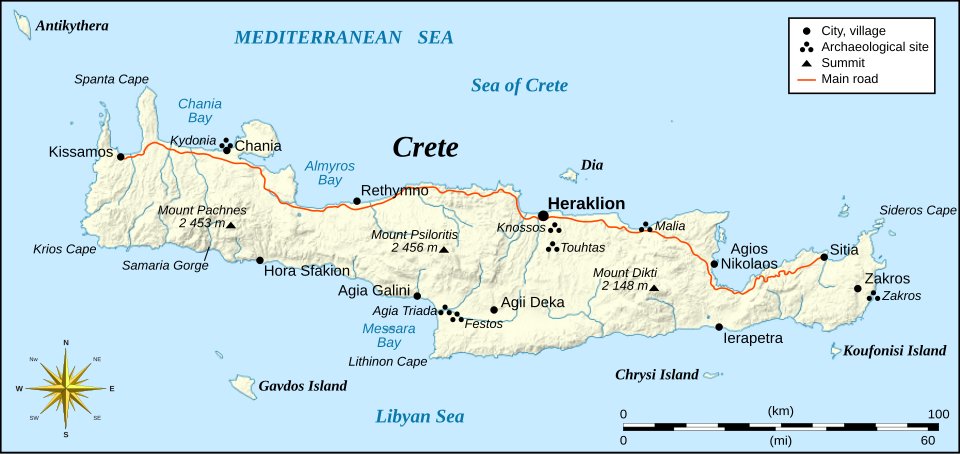
Of all the Greek myths, few are as vivid as the Minotaur: a monster, half man and half bull, shut in a maze beneath a king's palace and fed on young Athenians until a hero came to kill it. The story was set at Knossos on Crete. When archaeologists dug there around 1900, they found a real palace so large and so intricate that it is easy to see how a legend of a labyrinth might grow around it. What they did not find was the Labyrinth itself.
The myth
Britannica tells the story this way. Poseidon sent King Minos a snow-white bull to sacrifice. Minos kept it instead, and as punishment Poseidon made the queen, Pasiphae, fall in love with the bull. Her child, the Minotaur, had a man's body and a bull's head, and was shut up in the Labyrinth that the craftsman Daedalus built for Minos. Wikipedia's article on Knossos summarises the same myth.
Then came the tribute. After Minos's son was killed by the Athenians, Britannica says, Minos demanded that seven young men and seven young women be sent from Athens to be devoured by the Minotaur, every ninth year in one version and every year in another. The Athenian hero Theseus volunteered to go and, helped by the king's daughter Ariadne, killed the monster. Wikipedia adds the best-known detail: he found his way out by following a thread.
A real palace on a real hill
Knossos is very much a real place. Britannica describes it as the principal centre of Minoan civilisation, the earliest of the Aegean civilisations, standing on a knoll where two streams meet about 8 kilometres inland from Crete's northern coast. Wikipedia calls it an archaeological site and ancient urban centre, and notes that its name appears in the Bronze Age Linear B script as 'Ko-no-so'.
People lived there very early. According to Britannica, the first inhabitants probably arrived from Anatolia in the seventh millennium BC and farmed wheat and raised livestock. The first palace was built at the start of the Middle Minoan period, around 2000 BC. An earthquake around 1720 BC levelled most of it, and the palace was rebuilt on a grander scale, with colonnades and flights of stairs linking buildings on the slope. That rebuilt palace is largely what visitors see today.
Who dug it up
The first modern excavation was not Evans's. Wikipedia says the Cretan merchant and antiquarian Minos Kalokairinos dug at Knossos for several weeks in 1878 and 1879, exposing part of the west wing and storerooms holding large storage jars. By coincidence, he shared his first name with the legendary king.
Large-scale work began in 1900 under the British archaeologist Arthur Evans, a date both Britannica and Wikipedia give. Wikipedia says Evans uncovered most of the palace and much of the surrounding town, and that he coined the name 'Minoan' for the Bronze Age civilisation of Crete, after the mythical Minos. In effect, the myth gave its name to the culture.
Why a palace might become a labyrinth
The palace was enormous and complicated. Britannica describes administrative and ceremonial rooms on the west side of a central court, a throne room that still holds a gypsum chair, long narrow storerooms for grain, oil and treasure, workshops, residences, and an elaborate system of drains and pipes. Wikipedia lists courts, monumental entrances, staircases, storerooms, light wells and ritual spaces arranged over several levels.
Wikipedia suggests that this maze-like plan probably contributed to the later Greek image of Knossos as the home of the Labyrinth. It also mentions a much-repeated idea that the word 'labyrinth' is related to 'labrys', a double axe, a symbol found in Minoan Crete, but says that link is still debated. Both are reasonable explanations. Neither is proven.
Britannica's account of the palace mentions frescoes of dancing, sport and dolphins. Wikipedia's article on the Minotaur reviews older scholarly suggestions that the myth reflects a Cretan bull cult. That is an interpretation, not an established fact. There is no evidence that anything like the Minotaur ever lived.
The Labyrinth that was never found
Wikipedia's article on the Minotaur states it simply: the ruins of the palace at Knossos were discovered, but the Labyrinth never was. Later Greeks clearly connected the two anyway. Wikipedia notes that coins minted at Knossos from around the fifth century BC carried labyrinth designs, so the city itself embraced the legend.
Knossos also changed hands. Britannica says Mycenaean Greeks from the mainland took control sometime in the fifteenth century BC, replacing the older Linear A script with Linear B, an early form of Greek. Wikipedia says the Linear B tablets found at Knossos record land, livestock, textiles, offerings and labour, the paperwork of a real administration. Myth or no myth, this was a powerful centre with a long reach across Crete.
Myth and memory
It is tempting to read the Minotaur story as a garbled memory of a time when Crete was powerful and Athens was weak. That is a popular interpretation, but it cannot be tested, and this page does not claim it. What can be said with confidence is narrower and still remarkable: Greek storytellers placed a king, a craftsman and a maze at Knossos, and three thousand years later archaeologists found there the largest and most complex palace of Bronze Age Crete.
The monster stays in the realm of myth. The palace, with its stairs and storerooms and endless corridors, is real, and you can still walk through it.