The Antikythera Mechanism
1901
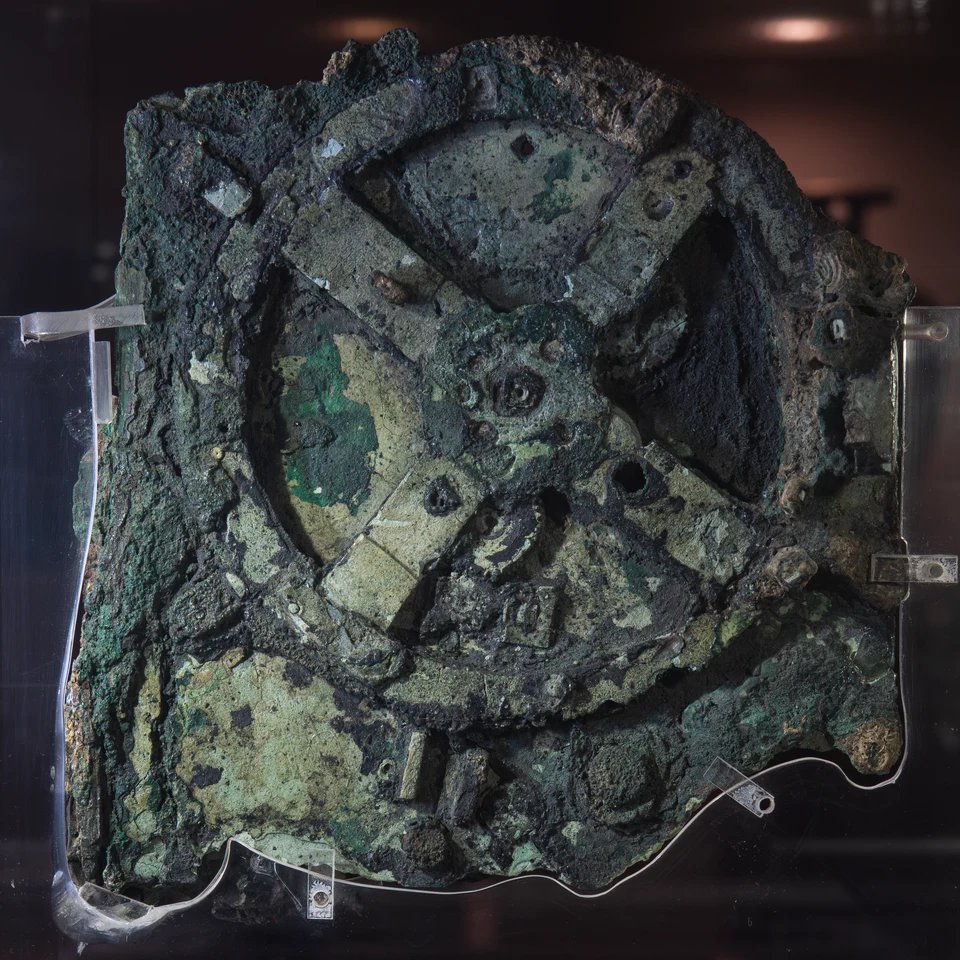
Greek myth is full of clever machines: bronze giants, self-moving tripods, the inventions of Daedalus. Most of them stayed in stories. One real machine, though, came up from the seabed off a small Greek island at the start of the twentieth century, and it was more sophisticated than anyone thought the ancient world could build. More than a century later, researchers are still working out everything it could do.
A lump from a shipwreck
Around the turn of the twentieth century, a crew of sponge divers found an ancient wreck off Antikythera, a small island between the Peloponnese and Crete. Wikipedia's account says the divers, led by Captain Dimitrios Kontos, found it in 1900, and that a recovery operation with the Greek navy brought up statues, pottery, glassware, coins and other cargo over 1900 and 1901. Both the 2006 Nature paper by Tony Freeth and colleagues and Wikipedia name 1901 as the year the mechanism itself came out of the water.
At first it did not look like much. Wikipedia describes it as a lump of corroded bronze and wood that sat unnoticed while museum staff concentrated on the far more obvious statues. Wikipedia says that in 1902 someone noticed a gear wheel set into one of the pieces, and the object began to attract attention. Even then, many scholars doubted that something so intricate could really belong with the rest of an ancient cargo.
The ship itself is usually dated to the first century BC. Wikipedia puts the wreck at about 70 to 60 BC, based on several lines of evidence. The Nature paper calls it a Roman shipwreck. How the device came to be on board is not known.
What is left
Time and seawater have not been kind. The 2021 study in Scientific Reports, also led by Freeth, says the mechanism is now split into 82 fragments and that only about a third of the original survives, including 30 corroded bronze gearwheels. Wikipedia gives the same figures: 82 fragments and 30 surviving gears, all held at the National Archaeological Museum in Athens.
The gears are small and finely cut. Wikipedia notes that the largest is about 13 centimetres across and originally had 223 teeth.
Looking inside with X-rays
For much of the twentieth century the fragments were too fragile and too encrusted to read properly. Wikipedia credits the historian Derek de Solla Price with reviving interest from the 1950s, taking X-ray and gamma-ray images in the early 1970s and publishing his results in 1974.
The big leap came in 2005. The Nature paper describes a project that combined surface imaging with high-resolution X-ray tomography of all the surviving pieces, letting researchers see gears hidden inside the corroded lumps and read faint inscriptions that no one had seen for two thousand years. The team reported that the work roughly doubled the number of deciphered inscriptions. Wikipedia summarises the same campaign, led from Cardiff University.
What they found was startling. According to the Nature paper, the mechanism predicted solar and lunar eclipses using Babylonian arithmetic cycles, tracked a lunar calendar and the phases of the Moon, and included a clever pin-and-slot arrangement that reproduced the Moon's changing speed across the sky. The authors linked that last feature to a theory of the Moon's motion developed by the astronomer Hipparchos in the second century BC. Wikipedia makes the same connection and says Hipparchus may even have been consulted on the design, though that is speculation.
A model of the cosmos
The back of the machine was largely solved after 2005. The front was harder, because much of the evidence is missing. The 2021 Scientific Reports paper describes inscriptions that refer to the Sun, the Moon and all five planets known in antiquity, and to how they were displayed at the front as a model of the cosmos. Both that paper and Wikipedia mention a 2016 reading of numbers connected with the cycles of Venus and Saturn.
Using those clues, the 2021 team proposed a new reconstruction with nested rings showing the Moon, the Sun, the planets and the date, driven by compact sets of gears. They are careful about what this means. The paper says plainly that, because so much has been lost, it cannot claim its model is a replica of the original, and that some features, such as a pointer for the Moon's nodes, are hypothetical. It is the best fit to the evidence so far, not a final answer.
Wikipedia adds that the device could also track the four-year cycle of the Olympic Games, a detail the 2021 paper lists among its functions too.
When was it made, and by whom?
Here the honest answer is that nobody is sure. The Nature paper dates construction to around the end of the second century BC. Wikipedia lists several proposals, from about 205 BC to about 87 BC, plus separate arguments about the date the machine was first set to, and says only that it must be older than the wreck. No maker's name survives.
Its sophistication raises its own puzzle. The Nature authors called it technically more complex than any known device for at least a thousand years afterwards. Wikipedia says machines of similar complexity did not reappear until the fourteenth century in western Europe, and that its quality suggests there were predecessors that have not been found. That is a reasonable inference, but it is an inference. For now, the Antikythera mechanism stands alone.
Myth, legend and the real thing
Because it looks out of place, the mechanism attracts wild claims about lost civilisations and visitors from elsewhere. The researchers who have studied it most closely point the other way. The 2021 paper describes it as a blend of Babylonian astronomical cycles, mathematics from Plato's Academy and Greek astronomical theory, which is to say a product of the ancient Mediterranean world and its accumulated knowledge.
That may be the most remarkable part of the story. The Greeks told legends about craftsmen who built impossible machines. In the Antikythera mechanism, we have physical proof that real Greek craftsmen built something that, until a century ago, would have sounded just as impossible.
Further reading
- Nature (2006): Decoding the Antikythera Mechanism
- Scientific Reports (2021): A Model of the Cosmos in the Antikythera Mechanism
- Wikipedia: Antikythera mechanism