Phineas Gage and the Iron Rod
September 13, 1848
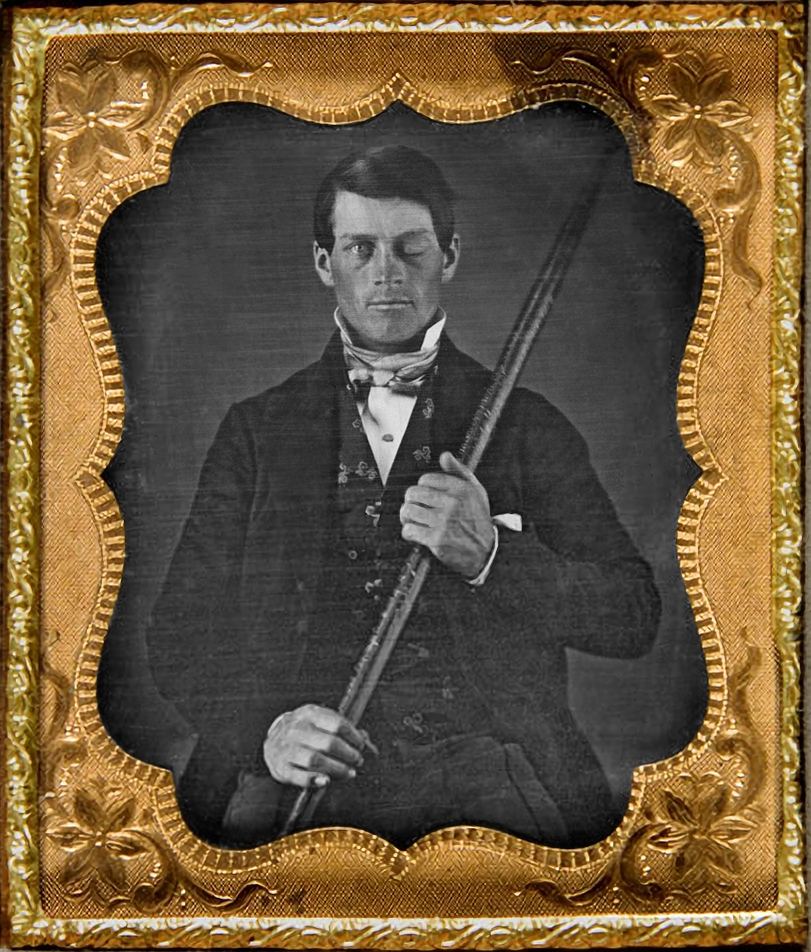
On an autumn afternoon in 1848, a railroad foreman in Vermont had an iron bar more than a metre long blown straight through his skull, and then sat up and talked about it. Phineas Gage lived for almost twelve more years. What happened to his personality in that time, and what later writers claimed happened, turned him into the single most cited patient in the history of neuroscience.
A foreman with a tamping iron
Gage was 25 and in charge of a crew cutting a bed for a new railroad through rock near the village of Cavendish. Blasting worked by drilling a hole, filling it with powder, adding a layer of sand and packing it down with a tamping iron. Gage's iron was made for the job: a smooth, tapered bar that Smithsonian magazine gives as 43 inches long, an inch and a quarter thick and weighing 13.25 pounds, figures that match the Harvard measurements cited on Wikipedia.
Business enough
On 13 September the powder went off while Gage was tamping it. The iron shot upward, entered under his left cheekbone, passed behind his left eye and out through the top of his skull. Wikipedia, citing the physician John Harlow's accounts, says it landed point-first about 80 feet away; Smithsonian simply says several dozen feet.
The most startling part is what came next. Smithsonian says Gage may not have lost consciousness at all, and according to the accounts collected on Wikipedia he spoke within minutes and rode upright in an oxcart to his lodgings, and Smithsonian quotes the line he is said to have greeted the first doctor with: 'Here is business enough for you.'
Dr Harlow's patient
The man who took over his care, John Martyn Harlow, kept the wound clean through what his own published reports, as summarised on Wikipedia, describe as weeks of delirium and infection. Gage lost the sight of his left eye but recovered physically, and, according to Harlow's account, about ten weeks after the accident he was well enough to go home to his family in New Hampshire.
It was Harlow's later description that made Gage famous. Smithsonian quotes it: his friends found him 'no longer Gage'. The balance between his 'intellectual faculties and animal propensities' seemed broken; he swore, ignored advice and could not stick to plans. The railroad contractors, who had considered him their best foreman, would not take him back.
The strangest details
Harvard surgeon Henry Bigelow was so sceptical that he brought Gage to Boston to examine him, then wrote that he had been personally convinced. The tamping iron itself was engraved during Gage's life with the words 'This is the bar that was shot through the head of Mr Phinehas P. Gage', misspelling his first name; both Smithsonian and Wikipedia quote the inscription.
Gage later spent several years in Chile driving coaches, a detail both Smithsonian and Wikipedia record; Wikipedia, quoting Harlow, says he often drove a heavily laden coach drawn by six horses. He finally joined his family in California, where seizures set in and he died in May 1860, aged 36. According to Wikipedia, his family later had his skull exhumed at Harlow's request and delivered it to him.
Myth versus reality
Popular retellings often describe Gage as turning into a violent, drunken drifter for the rest of his life. Smithsonian, drawing on the psychologist Malcolm Macmillan, says those descriptions grew well beyond anything Harlow wrote. Wikipedia goes further, summarising Macmillan's argument that Gage made a reasonable 'social recovery', and that holding down a demanding job in Chile suggests the worst changes were temporary. Wikipedia records a claim that he was briefly an exhibit at P. T. Barnum's museum in New York, but says there is no evidence he ever toured with a circus, so we treat any show-business stint as uncertain.
The other myth is that Gage proves 'personality lives in the frontal lobes'. His case was the first to suggest a link between brain damage and personality change, which is why it fills textbooks. But the details of his behaviour were thinly recorded, and the exact damage has been reconstructed from his skull rather than observed.
A face, finally
For 150 years nobody knew what Gage looked like apart from a plaster cast of his head. Then in 2009, as Smithsonian tells it, a pair of Baltimore collectors realised that an old daguerreotype they had labelled 'One-Eyed Man with Harpoon' showed a man holding a tamping iron with writing on it. Comparison with the bar and cast at Harvard convinced specialists that it was Gage: well dressed, scarred, and holding the iron that changed his life. Macmillan told Smithsonian he had also learned of another photograph kept by one of Gage's descendants.
Aftermath
Gage's skull, the tamping iron and the cast of his face are still at the Warren Anatomical Museum at Harvard Medical School, where Smithsonian calls them the most sought-out items in the collection. Macmillan has found that about two-thirds of introductory psychology textbooks mention him, usually in a sentence or two that leaves out the stagecoaches.
Further reading
- Smithsonian: Phineas Gage, neuroscience's most famous patient
- Wikipedia: Phineas Gage (extensively sourced to Macmillan)