Dating the Shroud of Turin
October 13, 1988
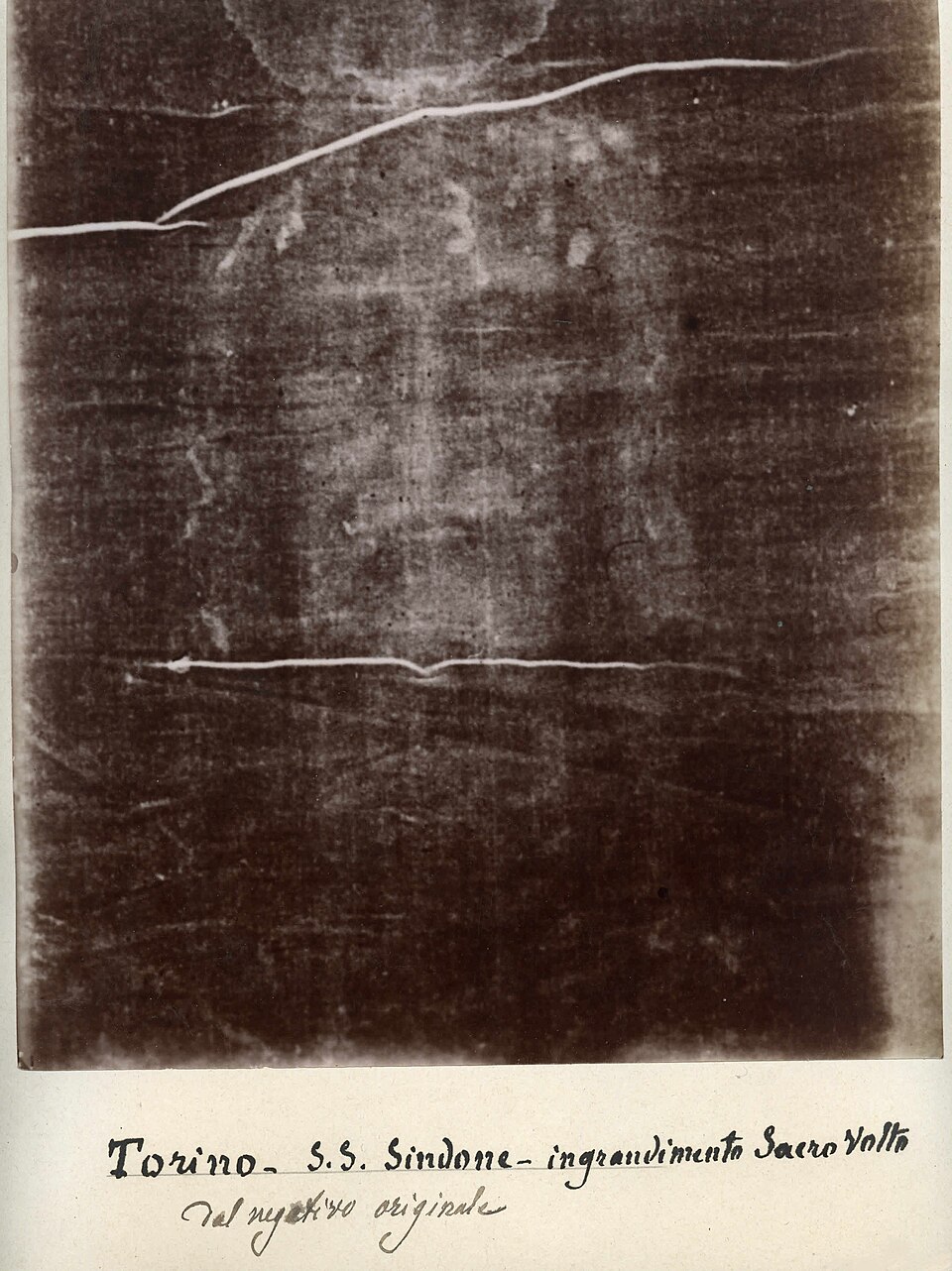
For centuries, a long strip of linen kept in Turin has been venerated by many Christians as the burial cloth of Jesus. Its faint image of a man, front and back, has moved pilgrims, puzzled scientists and divided opinion. In 1988 the Church allowed three laboratories to carbon-date small pieces of it. The results were announced with great confidence, yet the argument they were meant to settle is still alive. This is the story of that test, told with respect for what the shroud means to people who hold it dear.
The cloth and its image
Britannica describes the shroud as a linen cloth about 4.3 metres long and 1.1 metres wide, carrying two faint brownish images of the front and back of a man, as if a body had been laid along one half and the other half folded over the head. The markings have been read as matching the wounds of the crucifixion described in the Gospels. Wikipedia describes the cloth the same way, as a linen that tradition associates with the crucifixion and burial of Jesus.
One discovery made the image more mysterious, not less. Britannica notes that in 1898 it was observed that the images behave like photographic negatives rather than positives. Tests from the 1970s, it adds, tried to determine whether the image came from paint, scorching or something else, and none was conclusive.
A documented history from the 1350s
The shroud's written history begins in medieval France. Britannica says the first record dates from 1354, when it was in the possession of the knight Geoffroi de Charny, lord of Lirey, and that there is no record of how he obtained it. Wikipedia similarly places the first certain appearance of the shroud in the 1350s.
Its authenticity was questioned almost immediately. According to Britannica, in 1389 the local bishop of Troyes denounced it as a painting. The antipope Clement VII allowed it to be shown as an 'image or representation' of the true shroud, while later popes took its authenticity for granted. The cloth passed to the House of Savoy, was damaged by fire and water at Chambéry in 1532, and was moved to Turin in 1578, where it remains.
Testing a relic
Carbon dating was first suggested in the 1960s, but Wikipedia says permission was refused because the methods of the time would have destroyed too much cloth. New techniques in the 1970s and 1980s needed far smaller samples. After years of negotiation, which Wikipedia describes in detail, the Vatican chose three laboratories using accelerator mass spectrometry: Oxford, the University of Arizona in Tucson and ETH in Zurich. The British Museum's research laboratory coordinated the work.
The Nature paper reporting the results, published on 16 February 1989 by researchers from all four institutions, confirms that very small samples were dated by accelerator mass spectrometry at Arizona, Oxford and Zurich, and that three control samples of independently known age were dated alongside them. Britannica says the samples were roughly the size of a postage stamp. Wikipedia gives the sampling date as 21 April 1988, in Turin Cathedral.
The result
On 13 October 1988, Wikipedia records, Cardinal Anastasio Ballestrero, Archbishop of Turin, announced at a press conference that the linen had been dated to 1260-1390 AD with 95 per cent confidence. Britannica gives the same range. The Nature paper's abstract went further, saying the results provide conclusive evidence that the linen is mediaeval.
The range fits neatly with the cloth's first documented appearance in the 1350s, a point Wikipedia makes. For many observers that was the end of the matter.
Why the debate continues
It was not the end for everyone. Britannica notes that some scientists raised doubts about the method. Wikipedia describes several lines of criticism, including the abandonment of a planned blind-test protocol, because the shroud's distinctive weave could not be matched in control samples, and arguments that the samples came from an unrepresentative part of the cloth. It also says that attempts to overturn the dating have so far been unsuccessful, that the laboratories stand by their results, and that the Church has been unwilling to release new samples since 1989.
Newer studies have kept the question open. Britannica describes a 2022 Italian study that used wide-angle X-ray scattering on a small thread and found the linen's structural ageing compatible with a cloth from the first century, proposing contamination as an explanation for the carbon date. The same study's authors made no claim about authenticity and said further testing was needed. Wikipedia quotes a 2019 comment from a Nature editor that nothing published so far gives compelling reason to think the 1989 study was substantially wrong, but that it was apparently not definitive either.
Faith and evidence
The Catholic Church has never ruled on whether the shroud is the burial cloth of Jesus. Britannica says that after the 1988 results the Vatican encouraged further scientific study and recommended that Christians continue to venerate the shroud as an inspiring image of Christ. It also notes that Pope John Paul II called it 'a mirror of the Gospel', and that public displays have continued, including one in 2010.
So the shroud lives in two worlds at once. As a scientific object, the best-known test dates its linen to the Middle Ages, and that result has not been overturned. As an object of devotion, it continues to draw pilgrims who find in it a powerful reminder of the Passion. Those two things can be described side by side without one cancelling the other.
Further reading
- Nature (1989): Radiocarbon dating of the Shroud of Turin
- Britannica: Shroud of Turin
- Wikipedia: Radiocarbon dating of the Shroud of Turin