The Lake Nyos Disaster
August 21, 1986
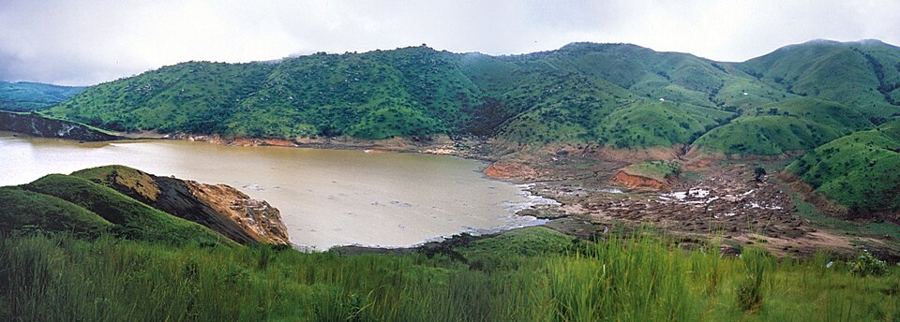
There was no fire, no lava and no warning anyone recognised. On a calm evening in August 1986, a deep crater lake in north-western Cameroon suddenly released an enormous cloud of carbon dioxide. Heavier than air, the invisible gas poured down the valleys and smothered villages. By morning about 1,700 people were dead, many in their sleep.
A beautiful, dangerous lake
Lake Nyos sits in a volcanic crater high in the hills of north-western Cameroon. The US scientific team that investigated the disaster, reporting through the US Geological Survey, described it as normally deep blue and peaceful.
The danger was invisible. A 2005 paper in the Proceedings of the National Academy of Sciences (PNAS) explains that carbon dioxide from magma deep underground dissolves into groundwater, enters the lake bottom through springs and accumulates in the deep, layered water. The Science paper by the investigating team reached the same conclusion about the gas's magmatic origin.
The night of 21 August
The USGS report reconstructs the evening. Heavy rain had passed, and by 9:30 pm the weather was calm. Then came rumbling sounds lasting perhaps 15 to 20 seconds. Many people who came outside felt warmth, smelled rotten eggs or gunpowder, and quickly lost consciousness; others never woke. One observer on high ground heard bubbling and saw a white cloud rise from the lake with a large wave.
Investigators later found vegetation damage showing a surge of water had washed about 25 metres up the southern shore, a figure Wikipedia also gives, and the lake level had dropped by about a metre. Wikipedia says the gas stayed deadly for roughly 23 km, reaching the villages of Nyos, Kam, Cha and Subum.
Waking among the dead
Survivors woke 6 to 36 hours later, the USGS team found, to discover oil lamps gone out though they still held oil, animals and relatives dead, and themselves weak and confused. The deaths were patchy: in one pen four of five goats died, and in a nearby home four of nine people survived. Wikipedia quotes a survivor, Joseph Nkwain of Subum, describing waking up unable to speak.
What investigators found
Because the lake lies in a volcano, many first assumed an eruption. The investigating team's 1987 paper in Science concluded that the gas was mostly carbon dioxide stored in the lake's deep water, that the victims died of carbon dioxide asphyxiation, and that there was no significant direct volcanic activity; the USGS report says the same. Wikipedia notes that a similar event at nearby Lake Monoun in 1984 is the only other limnic eruption on record.
What set it off is still unsettled. The USGS report calls the trigger undetermined; Wikipedia says most geologists suspect a landslide, while some think a small eruption on the lake bed was involved.
Defusing the lake
The gas keeps coming. PNAS warns that continuous recharge means such lakes can repeat the cycle, and describes the fix: pipes that lift deep, gas-rich water to the surface, where the gas escapes harmlessly and the flow sustains itself once started. PNAS and Wikipedia both date the first permanent pipe at Nyos to 2001, and the PNAS modelling argued more pipes would be needed.
Aftermath
Lake Nyos showed that a lake can kill without any eruption of lava, and it changed how scientists watch gas-charged lakes. It remains one of the strangest natural disasters on record.
Further reading
- USGS: Final report of the US scientific team on the Lake Nyos disaster (PDF)
- PNAS: Degassing Lakes Nyos and Monoun