The Oracle of Delphi and the Gas Theory
2001
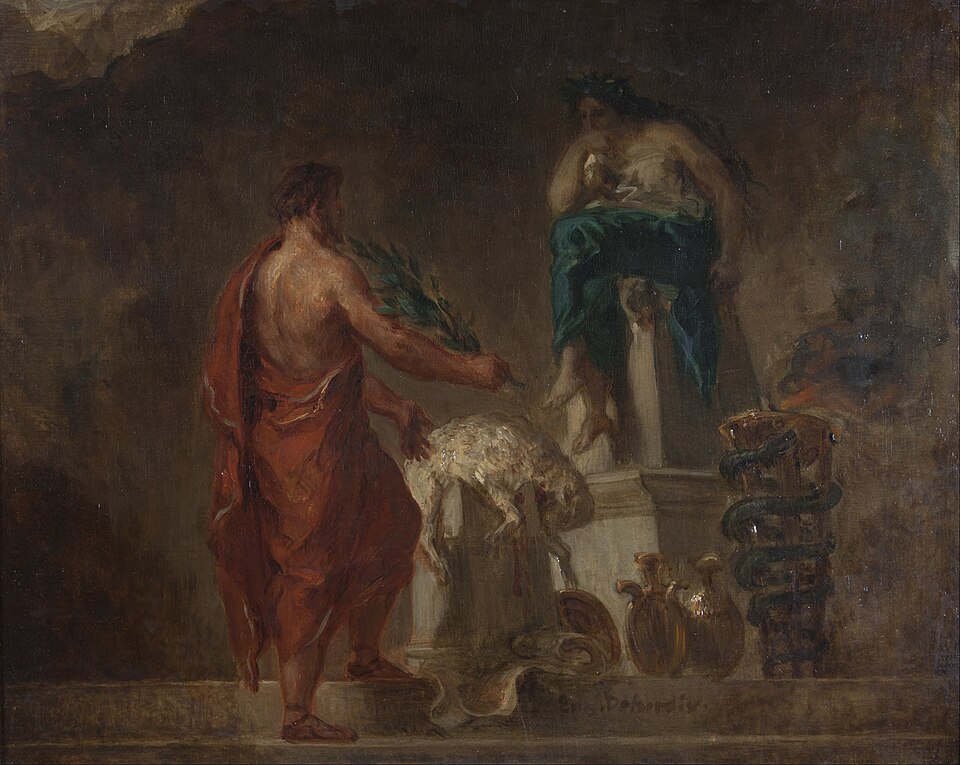
For more than a thousand years, people climbed to a temple on the slopes of Mount Parnassus to put their questions to Apollo. The answers came through a woman, the Pythia, who sat on a tripod in the temple and spoke in an altered state that the Greeks believed was divine inspiration. Ancient tradition linked her trance to something rising from the ground. Modern scholars first dismissed that as legend, then geologists came back with evidence that complicated the picture. The result is one of the liveliest arguments in ancient history.
The oracle and what the Greeks believed
Britannica describes the Delphic oracle as the most famous oracle of the ancient world, believed to deliver prophecies from the god Apollo from his temple at Delphi. It says she reached the height of her fame between about the eighth and fourth centuries BC, when lawmakers, colonists and founders of cults sought Apollo's advice, especially before wars. Wikipedia's article on the Pythia gives a similar picture of a priestess who was pre-eminent by the end of the seventh century BC and consulted for centuries afterwards.
For the people who consulted her, this was a religious act, not a curiosity. Britannica describes the ritual: sponsors, a ritual cake, an animal sacrifice, purification in the Castalian spring, and the priestess descending to a chamber in the temple to sit on a sacred tripod. In Greek belief, the god spoke through her. Her words were then put into verse by priests, often famously ambiguous.
The ancient clue: vapour from the earth
Ancient sources connected the Pythia's state to something in the place itself. Wikipedia notes that Plutarch, who served as a priest at Delphi around the late first and early second centuries AD, associated the oracle's powers with vapours, and describes a sacred 'pneuma' emerging near the tripod. It quotes his description of the chamber being occasionally filled with a sweet fragrance, like expensive perfume. The Science report on the debate also refers to the sweet smells Plutarch described.
A popular later version of the story put the priestess on a tripod over a chasm, breathing fumes that sent her into a trance. Science's report summarises that version and notes that it shaped how the oracle was imagined for a long time.
Dismissed as a myth
When French archaeologists excavated the temple, they did not find a chasm. Wikipedia says the excavations began in 1892 under Théophile Homolle, and that an influential 1904 article by Adolphe Paul Oppé argued that there had never been a chasm or vapour at all. According to Science, the story was dismissed as a myth during the first half of the twentieth century because excavation turned up no sign of a chasm or a large fissure. For decades, Wikipedia says, the ancient accounts of an inspiring vapour were regarded as false.
The geologists return
That changed when a geologist looked at the ground itself. Science reports that in the late 1990s Jelle de Boer of Wesleyan University suggested two faults crossing directly under the temple could account for the chasm and the vapours. Wikipedia describes the same work, carried out with the archaeologist John Hale and others, identifying the Kerna fault running roughly north-south and the Delphic fault running east-west, intersecting about where the oracle's chamber probably stood.
Then came the chemistry. Science says de Boer's group found traces of ethylene, a sweet-smelling gas that can cause euphoria, in a local spring and proposed it as the likely source of the Pythia's trances. Wikipedia says water from the Kerna spring yielded about 0.3 parts per million of ethylene in samples taken in 2001, and that the team argued concentrations may have been higher in antiquity. Ethylene had been used as an anaesthetic, and supporters pointed out that its effects resembled descriptions of the Pythia. Britannica mentions the idea in a single cautious line: some have claimed her state was caused by gases such as ethylene and methane from fault lines under the temple.
The pushback
Not everyone was convinced. Science reports a 2006 study in the journal Geology by Giuseppe Etiope and colleagues, who brought a portable laser sensor to Delphi and found no ethylene. They did find significant carbon dioxide and methane seeping from the ground. They argued that the local rocks could not have produced ethylene in high enough amounts, and suggested that if gas affected the Pythia at all, it might have been through oxygen being depleted in a closed chamber. Wikipedia records the same alternatives, methane or carbon dioxide, and a later critic's view that ethylene is 'impossible'.
The original team pushed back in turn. Science quotes de Boer as saying ethylene remains the strongest candidate, and that benzene, another suggestion for the sweet smell, would have been too toxic. It also quotes geologist Luigi Piccardi, who agreed ethylene was probably not the cause but said more gas sampling was needed before the case could be closed. Wikipedia also notes that there is no direct evidence for the claim that ethylene levels used to be higher.
Where that leaves the story
Some things are now well supported: the temple sits on active faults, and gases do seep in the area today. Other things are not settled: whether any gas reached the priestess in useful amounts, which gas it was, and whether gas had anything to do with her state at all. Many historians would also stress that the Pythia's authority came from religious belief and the institution around her, not from chemistry.
The oracle fell silent in the late fourth century AD. Britannica says her last prophecy was reportedly delivered about 393, when Theodosius I acted against pagan worship; Wikipedia dates the temple's destruction under Theodosius to about 390. Either way, the questions she was asked are long forgotten. The question of what happened in her chamber is not.