The Strangest Olympic Marathon
August 30, 1904
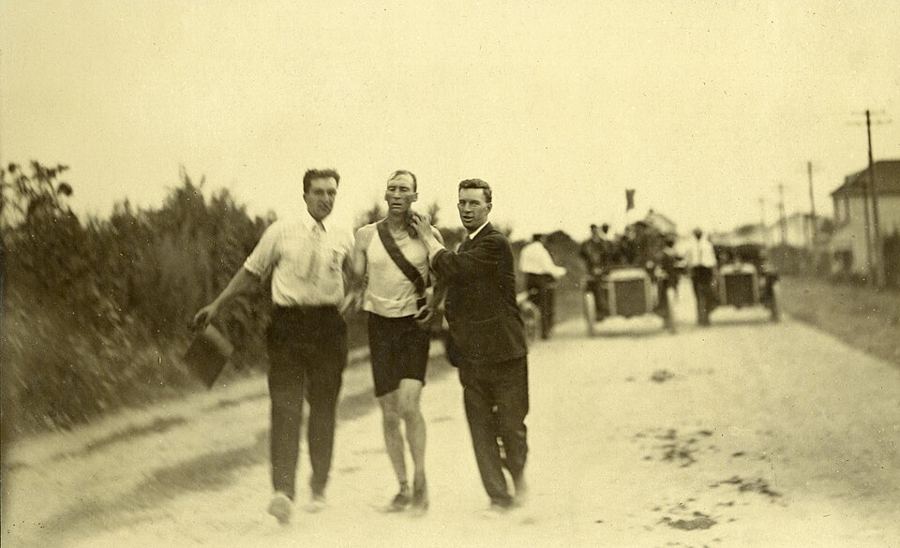
On 30 August 1904, 32 men set off on the Olympic marathon in St. Louis, Missouri. What followed was arguably the strangest race in Olympic history: brutal heat, choking dust, a single water stop by design, a 'winner' who had ridden much of the course in a car, and a real winner kept going on strychnine, egg whites and brandy.
The setting
The 1904 Olympics were held in St. Louis alongside the Louisiana Purchase Exposition, the World's Fair. The marathon field, as Smithsonian magazine describes it, included a handful of experienced American marathoners, among them Thomas Hicks, Sam Mellor, A. L. Newton, John Lordon and Michael Spring, but most of the starters were middle-distance runners and assorted oddballs.
Among them was Fred Lorz, a bricklayer who trained at night and qualified through a five-mile race. Two Tswana men from South Africa, Len Tau and Jan Mashiani, who were in St. Louis as part of the fair's South African exhibit, became the first Black Africans to take part in the modern Olympics.
The Cuban mailman
The most colourful entrant was Félix Carvajal, a former mailman from Cuba who had raised money for the trip by running demonstrations across the island. According to Smithsonian, he reportedly lost all his money in a dice game in New Orleans and had to walk and hitchhike to St. Louis. He turned up in a long-sleeved shirt, long dark trousers, a beret and street shoes. Legend has it that a fellow competitor cut his trousers off at the knee.
A course built for suffering
The race started at 3:03 p.m. in temperatures in the low 90s Fahrenheit. The course, about 24.85 miles, had seven hills and ran over roads inches deep in dust, littered in places with broken stone. Runners dodged traffic, wagons, trains, trolleys and dog walkers, while cars carrying officials and doctors drove alongside, throwing up dust that set off coughing fits.
There was only one official water stop, about 12 miles from the start. James Sullivan, the chief organiser of the Games, wanted to minimise fluid intake to study the effects of what he called purposeful dehydration, then a subject of research.
Collapse, dogs and rotten apples
William Garcia of California collapsed by the roadside about eight miles from the finish. The dust had coated his oesophagus and torn his stomach lining, and he was bleeding internally; Smithsonian says that without help he might have died. Lordon vomited and dropped out. Len Tau was chased a mile off course by a wild dog.
Carvajal, meanwhile, chatted with spectators as he ran. He asked people in a car for a peach, was refused, and playfully grabbed two. Later he ate apples from an orchard that turned out to be rotten, got stomach cramps, and lay down for a nap. He still finished fourth.
The man in the car
Fred Lorz suffered cramps at about the nine-mile mark and accepted a ride in one of the accompanying cars, waving to spectators and runners as he passed. After about 11 miles in the car, he got out and started running again. He reached the stadium first, in about 3 hours 13 minutes, and the crowd cheered. According to Wikipedia's summary of the race, he was photographed with Alice Roosevelt, the president's daughter.
The cheers turned to boos when the truth came out. Lorz claimed he had only finished as a joke. He was banned for life, but the ban was lifted after about six months, and in 1905 he won the Boston Marathon.
Strychnine and brandy
The rules of the time allowed runners to be assisted by their handlers, and Hicks received a lot of assistance. At the ten-mile mark his two-man crew refused him a drink and sponged his mouth with warm water instead. Seven miles from the finish they gave him strychnine mixed with egg whites. In small doses strychnine was then used as a stimulant; today it is best known as a rat poison. Smithsonian describes this as the first recorded instance of drug use in the modern Olympics, which had no rules against it.
When Hicks heard that Lorz had been disqualified, he rallied. His handlers gave him another dose of strychnine and egg whites, washed down with brandy, and bathed him in warm water. Over the last miles he began hallucinating; he believed the finish was still 20 miles away. He begged to eat and to lie down. In the stadium he could barely shuffle, and his trainers carried him over the line with his feet moving in the air. It took four doctors and an hour before he could leave the grounds. Hicks finished in 3:28:53, still the slowest winning time in Olympic marathon history.
Aftermath
Only 14 of the 32 starters finished. Hicks was declared the winner, Carvajal came fourth despite his nap, and Garcia recovered. The race has gone down as a model of how not to run a marathon, and a vivid reminder of how different early Olympic sport was from the regulated, drug-tested competition of today.
Further reading
As posted on X: read the Stranger Than History thread