The Radium Girls
1917
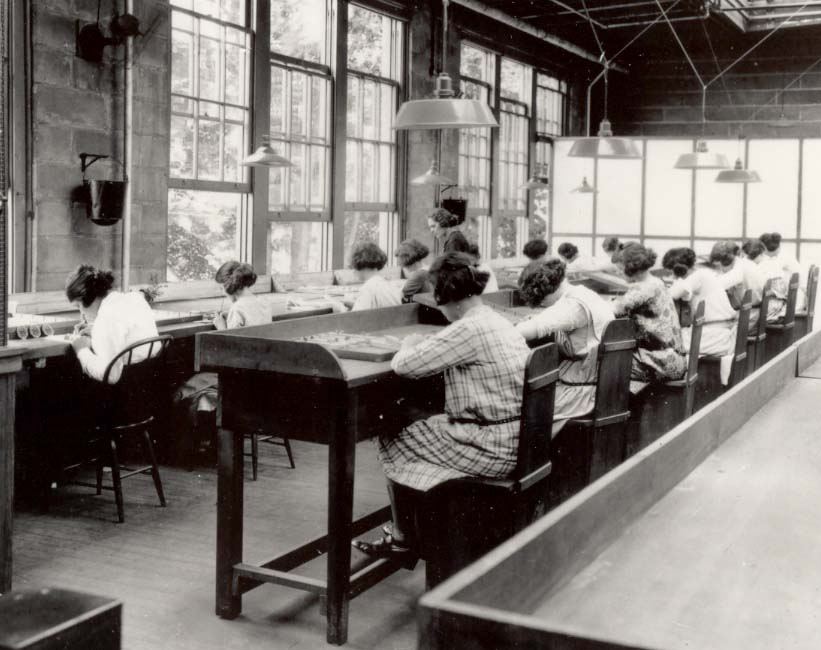
In the years around the First World War, a glowing watch dial was a small modern marvel, and painting one was a good job for a young woman. The paint contained radium. To keep a fine point on their brushes, the painters were taught to shape them with their lips, swallowing a little radium each time. The 'Radium Girls' who sickened and died, and the ones who sued, became one of the most important stories in the history of workplace safety.
A glowing job
By 1917, according to the Library of Congress's Headlines & Heroes blog, women were painting dials at the United States Radium Corporation plant in Orange, New Jersey. With America entering the First World War, some saw it as patriotic work: glowing dials for soldiers' watches and military instruments. Wikipedia also dates the Orange factory to around 1917. The work was well paid for women at the time, the Library of Congress notes. Wikipedia says the company's paint was sold as 'Undark'.
Radium watches stayed popular after the war. A different firm, the Radium Dial Company, opened a studio in Ottawa, Illinois, in late 1922, both the Library of Congress and Wikipedia say, and a third plant operated in Waterbury, Connecticut.
Lip, dip, paint
The fatal habit was simple. Fine brushes lost their shape, so, as Wikipedia puts it, supervisors encouraged the women to 'lip, dip, paint', shaping the bristles with their lips. The Library of Congress says they were instructed to point their brushes this way and were not warned of any danger. Some executives and scientists in the industry, it adds, were increasingly aware and protected themselves.
Radium is a chemical cousin of calcium, and the same review explains that part of it becomes fixed in bone. The painters developed anaemia, decay of the jawbone that came to be called 'radium jaw', and cancers. A 2021 review in the International Journal of Radiation Biology (on PubMed Central) traces the first public medical report of radium jaw to a New Jersey dentist, Theodor Blum, in 1923–24, and the first studies linking radium to the women's illnesses to the mid-1920s.
The New Jersey case
Five former dial painters in New Jersey sued US Radium starting in 1927. The Library of Congress says their case was hampered by a two-year statute of limitations and that delays provoked a backlash in the press; Wikipedia names the five as Grace Fryer, Edna Hussman, Katherine Schaub, Quinta McDonald and Albina Larice, and says it took Fryer two years to find a lawyer. On 4 June 1928, according to the Library of Congress, they accepted an out-of-court settlement. Wikipedia gives its terms as $10,000 each plus an annuity and medical costs.
The Ottawa women
In Illinois, the Library of Congress says, Radium Dial told its workers the New Jersey deaths were caused by mesothorium, not radium, and that its own paint was safe. When Catherine Wolfe Donohue and others tried to sue in 1935, the statute of limitations blocked them. Their hearing before the Illinois Industrial Commission finally came in July 1937, by which time the company had closed its Ottawa plant.
Donohue testified from her sickbed in 1938, and the women won. She died on 27 July 1938, the day after the company filed another appeal. Both the Library of Congress and Wikipedia say the US Supreme Court declined to hear the final appeal on 23 October 1939, leaving the ruling in place.
Myth versus reality
Popular retellings sometimes say the women painted their teeth and nails with the paint for fun. A summary of Claudia Clark's history Radium Girls, on Project MUSE, does mention painters decorating eyelids and nails before evenings out, but it is clear that lip-pointing was the main way radium entered their bodies. And the dangers were not entirely unknown at the time: the Library of Congress says some people in the industry knew enough to protect themselves.
The end of lip-pointing is fuzzy too. The PubMed Central review says many plants reported banning it around 1925 but some were slow, while the Project MUSE summary says it was abolished industry-wide in 1927.
Legacy
The Library of Congress calls the cases significant in the development of occupational safety and health standards, and Wikipedia says the lawsuits and publicity were a factor in establishing occupational disease law. Many of the women did not live to see the outcome.
Further reading
- Library of Congress: Radium Girls, Living Dead Women
- International Journal of Radiation Biology: Radium dial workers, back to the future (PMC)
Sources
- https://en.wikipedia.org/wiki/Radium_Girls
- https://blogs.loc.gov/headlinesandheroes/2019/03/radium-girls-living-dead-women/
- https://pmc.ncbi.nlm.nih.gov/articles/PMC10563809/
- https://muse.jhu.edu/article/29016/summary
- https://text-message.blogs.archives.gov/2018/01/04/the-radium-girls-at-the-national-archives/