Blowing the Gamboa Dike
October 10, 1913
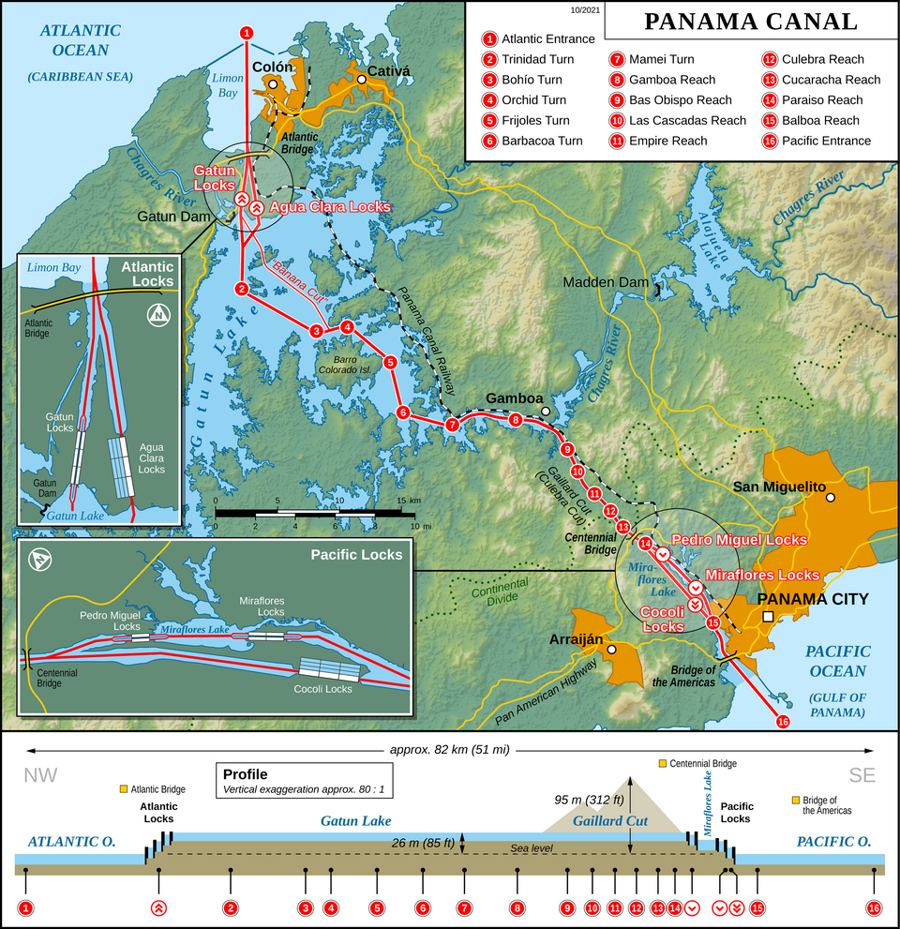
Most construction projects end with a ribbon. The Panama Canal's main construction ended with a remote-controlled explosion set off from more than 6,000 kilometres away. On the afternoon of 10 October 1913, President Woodrow Wilson pressed a key in Washington, and moments later a huge charge of dynamite tore open the Gamboa dike in Panama, letting the waters of Gatún Lake pour into the Culebra Cut.
Why there was a dike
The American canal used locks and a giant artificial lake, Gatún Lake, rather than cutting a channel at sea level. Its hardest stretch was the Culebra Cut, where the canal slices through the mountains of the Continental Divide.
According to the Canal Zone community history site CZBrats, an earth dike was built across the northern end of the Cut in 1908 near Gamboa, to stop floods on the Chagres River pouring into the excavation. Railway tracks ran across its top, and when Gatún Lake began to fill in 1912 the dike was raised and strengthened. By 1913 it was the last major obstruction between the lake and the Cut.
A button in Washington
Rather than have the dike blown up on site, the honour was given to the president. Wilson never travelled to Panama for the occasion. Instead, as the Hagley Museum and Library and CZBrats both describe, he pressed a telegraph key in the White House. The electrical signal travelled over landlines from Washington to Galveston, Texas, then along submarine cables to Panama, where it tripped a weight attached to the handle of a switch. The falling switch closed the circuit and fired the charges.
The New York Times reported the next day that the explosion went off at 'two minutes past 2 o'clock' Panama time, and Hagley gives the same time. The Times put the charge at eight tons of dynamite and the distance at more than 4,000 miles; Earth magazine, published by the American Geosciences Institute, gives the equivalent figures of about seven metric tons and more than 6,400 kilometres.
Water into the Cut
The water had in fact been trickling in for days. The Times reported that for the previous five days Gatún Lake had been flowing slowly into the Cut through pipes pushed through the dike, so the blast did not release a single giant wall of water. What it did was open the way.
After the explosion the lake water rushed into the partly filled Cut. According to both the Times and CZBrats, about half an hour later canal workers in small boats, including a canoe, steered through the rapids, followed by launches, while a crowd on the bank cheered and the whistles of locomotives and dredges sounded.
Two oceans meet?
Newspapers liked to say the blast joined the Atlantic and the Pacific. Earth magazine uses the same image, saying waters from the two oceans finally met in the Culebra Cut. The reality was a little less poetic: Gatún Lake is a fresh-water lake, and the canal lifts ships through locks rather than letting the oceans mix. The blast completed the water connection along the canal's route; it did not create a sea-level strait.
Not yet open
Blowing the dike did not open the canal to shipping. Dredging, widening and the clearing of landslides went on for months; the Culebra Cut was notorious for slides that kept refilling the channel. Earth magazine and the Miller Center both note that the canal was not opened to traffic until 15 August 1914, just as the First World War was beginning in Europe. The 1913 explosion is better seen as the symbolic end of the main construction.
Legacy
The Gamboa blast is remembered because of how it was done as much as what it did. In 1913 a president setting off an explosion in another country by pressing a key at his desk was a vivid demonstration of the telegraph network that now tied the world together. The American Presidency Project's timeline of Wilson's presidency records the moment in a single line: by pushing a switch in the White House, he caused the explosion that let water flow into the Panama Canal.
Further reading
- Earth magazine: Atlantic and Pacific waters meet in the Panama Canal
- Hagley: Wilson and the Gamboa Dike
As posted on X: read the Stranger Than History thread
Sources
- https://en.wikipedia.org/wiki/Culebra_Cut
- https://www.earthmagazine.org/article/benchmarks-october-10-1913-atlantic-and-pacific-waters-meet-panama-canal/
- https://www.hagley.org/research/news/hagley-vault/day-november-9-1906-theodore-roosevelt
- https://www.czbrats.com/Towns/gamboa.htm
- https://www.nytimes.com/1913/10/11/archives/canal-is-opened-by-wilsons-finger-gamboa-dike-blown-away-as.html
- https://www.presidency.ucsb.edu/documents/woodrow-wilson-event-timeline
- https://millercenter.org/president/woodrow-wilson/key-events