Mike the Headless Chicken
September 10, 1945
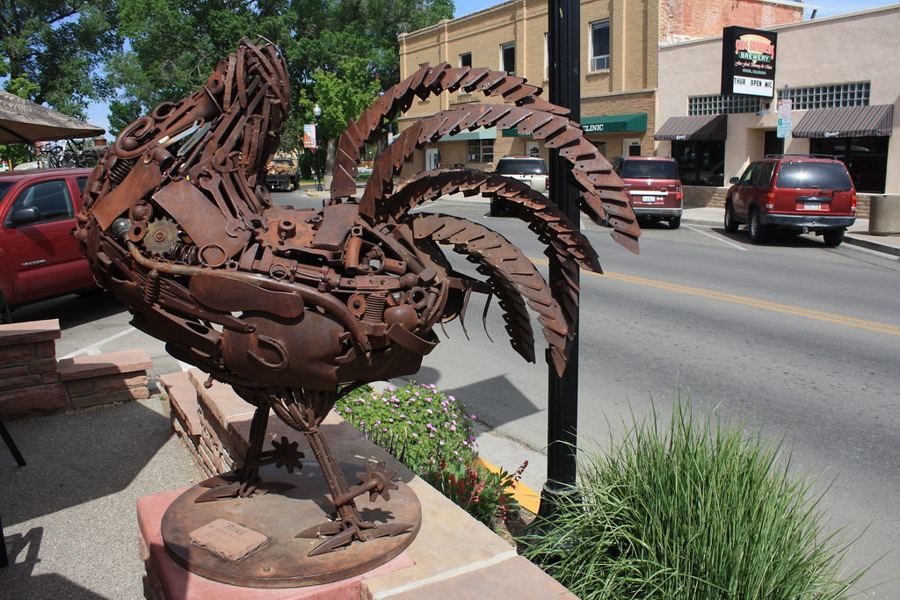
In September 1945 a farmer in Fruita, Colorado, went to kill a rooster for the table, and the rooster refused to die. With most of his head gone, 'Miracle Mike' lived for about 18 months, toured the United States, was written up in national magazines, and became one of the most famous chickens in history.
Killing day on the farm
On 10 September 1945, Lloyd Olsen and his wife Clara were killing chickens on their farm in Fruita, in western Colorado. According to the couple's great-grandson, Troy Waters, who told the story to the BBC, Lloyd would decapitate the birds and Clara would clean them. Of the 40 or 50 birds that went under the hatchet that day, one did not behave like the rest. It got up and walked around.
The Olsens put the headless rooster in an old apple box on the screened porch for the night. When Lloyd went out the next morning, the bird was still alive.
From bar bet to sideshow
Olsen took the rooster into town with the chickens he was selling at the meat market, and, Waters says, started betting people beer that he had a live headless chicken. Word spread. The local paper sent a reporter, and about two weeks later a sideshow promoter named Hope Wade travelled nearly 300 miles from Salt Lake City with an offer: take the bird on the road and make some money.
The Olsens ran a small, struggling farm, and they agreed. The bird, branded 'Miracle Mike the Headless Chicken', was first taken to Salt Lake City and the University of Utah, where he was put through tests. Life magazine covered the story, and Time magazine also wrote about him, according to Britannica.
On tour
Lloyd, Clara and Mike toured California and Arizona, and Hope Wade took Mike around the south-eastern United States while the Olsens went home for the harvest. Clara documented the trip in a scrapbook that the family still keeps.
People wrote to the family, around 40 or 50 letters in all. Not all were friendly: one compared the Olsens to Nazis. Another, from Alaska, offered to swap a wooden leg for one of Mike's drumsticks. Some letters were addressed only to 'the owners of the headless chicken in Colorado', and still arrived. Rumour has it, the BBC reports, that scientists at the University of Utah removed the heads of many other chickens to see whether any would live; none is known to have matched Mike.
How did he survive?
The BBC asked Dr Tom Smulders, a chicken expert at Newcastle University, to explain. Reports say the hatchet removed Mike's beak, face, eyes and an ear. But in a chicken, Smulders said, very little of the brain is in the front of the head; most of it sits at the back of the skull. He estimated that up to 80% of Mike's brain by mass, including almost everything that controls heart rate, breathing, hunger and digestion, was left intact.
At the time, people said Mike survived because his brain stem remained. Smulders explained that what was then called the brain stem in birds is now understood to be much of the bird brain proper. What surprised him most was that Mike did not bleed to death; a timely blood clot appears to have saved him.
Normally, Smulders noted, a beheaded chicken can run briefly because spinal cord circuits fire on their own, but for something like 15 minutes, not 18 months.
Keeping Mike alive
Mike, bred as a fryer chicken, could not eat or drink normally, so the Olsens dropped liquid food and water directly into his oesophagus with a dropper. They also had to clear mucus from his throat, which they did with a syringe.
The end
In spring 1947 the Olsens and Mike were in Phoenix, Arizona. One night they woke in their motel room to the sound of Mike choking. When they looked for the syringe, they realised they had left it at the sideshow, and before they could find an alternative, Mike suffocated. Britannica dates his death to March 1947.
For years, Waters says, Lloyd Olsen claimed he had sold the chicken to someone on the sideshow circuit. Only late in life did he admit that Mike had died in his care. He never said what he did with the body. Waters guesses it was left by the roadside in the desert somewhere between Phoenix and Fruita. Lloyd later told him he had enjoyed the chance to travel and see parts of the country he otherwise never would have seen.
Myths and money
Many retellings give precise figures for how much Mike earned, such as a monthly income in the thousands of dollars. Those numbers are hard to confirm. According to Waters, the idea that the family got 'filthy rich' was an exaggeration: Lloyd made 'a little money', enough to buy a hay baler, two tractors and a 1946 Chevrolet pickup, and went on farming for the rest of his life. Waters also says a neighbour plied Olsen with beer to learn his technique, and that others tried and failed to repeat it.
Legacy
Fruita has embraced its most famous resident. The town holds an annual Mike the Headless Chicken Festival each spring (in 2026 it ran 29-30 May), and a metal statue of Mike stands in town.
Further reading
- BBC: The chicken that lived for 18 months without a head (2015)
- Britannica: How Mike the chicken survived without a head
As posted on X: read the Stranger Than History thread