The War Over a Sailor's Ear
1731
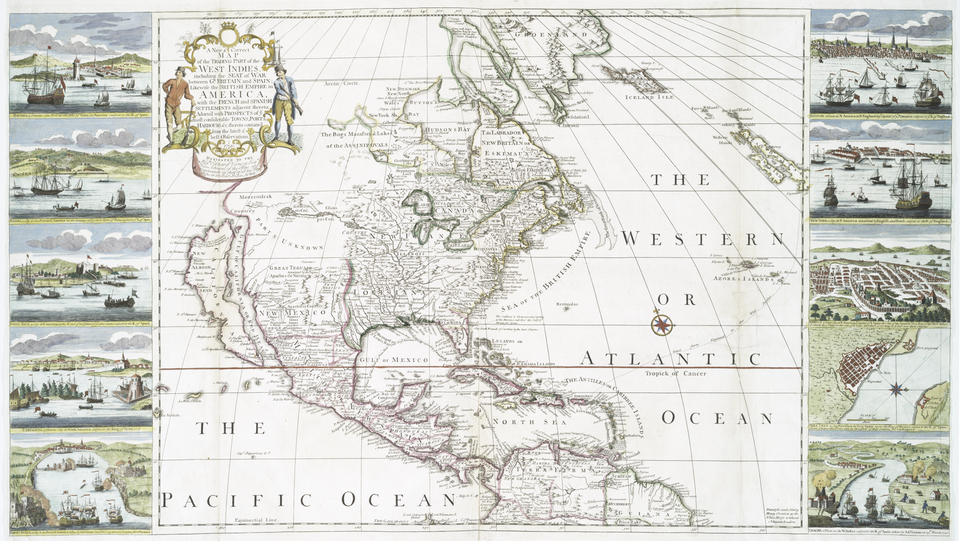
Wars have been started over land, gold and religion. One was named after a piece of a man's ear. In 1731 Spanish coast guards boarded a British ship in the Caribbean and cut off part of its captain's ear. The incident caused little stir at the time, but seven years later the captain, Robert Jenkins, told his story to the House of Commons, reportedly showing what he said was the ear, and within two years Britain and Spain were at war.
Smugglers and coast guards
In the early 18th century British merchants were allowed limited trade with Spain's American colonies, and a great deal of illegal trade went on alongside it. Wikipedia explains that a 1729 treaty let Spanish officials search British ships for contraband, and a 2013 article by the surgeons Evan Graboyes and Timothy Hullar in the journal Otology & Neurotology, which reviews the historical record, describes the Spanish demanding to search Jenkins' ship for smuggled goods.
Both sources note that Jenkins was not necessarily innocent. Graboyes and Hullar say some English accounts acknowledge he was a known smuggler, and Wikipedia says the Rebecca was found to be carrying smuggled sugar. The British naval commander in Jamaica privately admitted that British smugglers could be violent too, as both sources report.
The ear
According to Graboyes and Hullar, citing a report in Benjamin Franklin's Pennsylvania Gazette, the Rebecca was becalmed off Havana in April 1731 when a Spanish coast guard vessel overtook it. The Spaniards searched the ship, roughly hoisted Jenkins up the mast by a rope around his neck, and then one of them sliced at his left ear with a cutlass and tore it off. He was handed the piece and told to take it to King George. Britannica describes the same basic event: Spanish coast guards boarded his ship in the West Indies, plundered it, cut off his ear and set the ship adrift.
Exactly who wielded the cutlass is unclear; the journal article notes that some historians name the Spanish captain, Juan León Fandiño, and others a lieutenant. Wikipedia says the ear was partially amputated, according to Jenkins' later account.
Seven years later
Jenkins returned to Britain in 1731, and Graboyes and Hullar say his story aroused little interest at first; cropping ears was a fairly common punishment at the time. Things changed later in the decade, as tensions with Spain over trade and territory grew. Britannica and Wikipedia both describe opposition politicians, hostile to Prime Minister Robert Walpole, seizing on the story to whip up support for war.
In 1738 Jenkins appeared before a committee of the House of Commons. Britannica says he exhibited what he claimed was his own severed ear; the journal article dates the appearance to March 1738. Wikipedia says the incident was widely publicised from that point on. Britannica's careful wording is that he showed what he alleged was his ear.
The war
Walpole had tried to avoid war, but public pressure was too strong, as both Graboyes and Hullar and Wikipedia describe. Britain went to war with Spain in 1739. Britannica dates the start to October 1739; Wikipedia says King George II declared war in June and Parliament ratified it in October, and the journal article gives a declaration date of 19 October. The name 'War of Jenkins' Ear' came later.
Early on, Britain celebrated a quick victory when Admiral Edward Vernon captured Porto Bello in Panama in November 1739. Wikipedia says the song 'Rule, Britannia!' was first performed at a London dinner honouring Vernon in 1740, and that Portobello Road in London is named after the victory. The biggest operation, a British attack on Cartagena in present-day Colombia in 1741, failed with heavy losses, according to Wikipedia.
How it ended
Both Britannica and Wikipedia say the conflict merged into the much bigger War of the Austrian Succession in Europe. Wikipedia says fighting formally ended with the Treaty of Aix-la-Chapelle in 1748, which restored the pre-war situation, leaving Britain without the gains it had hoped for in the Americas.
Graboyes and Hullar conclude that Jenkins' ear was a pretext rather than a cause: with both countries competing for Caribbean trade, conflict was probably unavoidable. The ear simply gave the war a name nobody has forgotten.
Further reading
- Britannica: War of Jenkins' Ear
- Graboyes & Hullar, 'The War of Jenkins' Ear', Otology & Neurotology (PMC)
- Wikipedia: War of Jenkins' Ear