The Great Moon Hoax
August 25, 1835
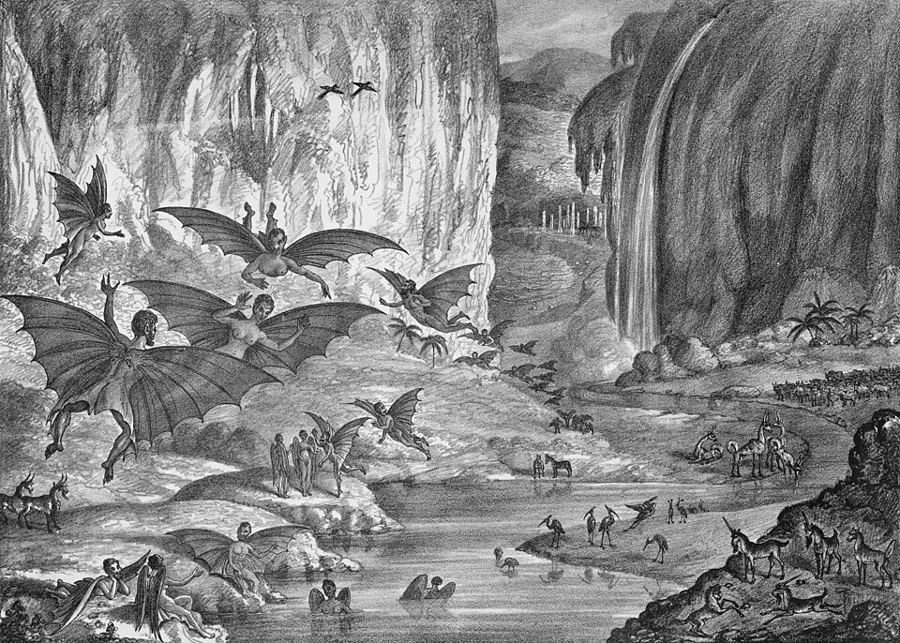
In late August 1835, readers of a cheap New York daily called The Sun opened their papers to astonishing news. Using a gigantic new telescope at the Cape of Good Hope, the famous astronomer Sir John Herschel had supposedly seen forests, lakes, herds of bison, unicorns and winged humanoids on the Moon. None of it was true, and Herschel had nothing to do with it.
Life on other worlds
The hoax landed in a culture already primed for it. The Smithsonian Libraries' Fantastic Worlds exhibition describes how the question of life on other planets, the 'plurality of worlds', was a hot topic in the early 1800s. William Herschel had discovered Uranus in 1781, and his son John was continuing his work; in the 1830s John was in fact at the Cape of Good Hope cataloguing the southern skies, as both the Smithsonian Libraries and Wikipedia note.
Great astronomical discoveries
According to Wikipedia, The Sun advertised the story on 21 August 1835 as an upcoming feature reprinted from Edinburgh, and the first of six articles appeared on 25 August. The articles claimed Herschel had used an immense telescope 'of an entirely new principle' to see the lunar surface in extraordinary detail.
What he supposedly saw grew stranger with each instalment. Wikipedia lists bison, single-horned goats, tiny zebras, unicorns, two-legged tailless beavers and, finally, bat-winged humanoids who built temples. The Smithsonian Libraries confirm the 'man-bats', which the articles gave the scientific-sounding name Vespertilio homo.
Who wrote it
The articles were unsigned. Both the Smithsonian Libraries and Wikipedia attribute them to Richard Adams Locke, a writer at The Sun. Wikipedia says Locke publicly admitted authorship in 1840 in a letter to a weekly paper, the New World.
Edgar Allan Poe was not pleased. Wikipedia records that Poe claimed the story plagiarised his own recently published tale of a balloon voyage to the Moon, 'The Unparalleled Adventure of One Hans Pfaall'.
Myth versus reality
The popular version says The Sun became the world's best-selling paper overnight. The Smithsonian Libraries say the story was repeated across continents, making The Sun 'the best-known newspaper in the world'. Wikipedia, though, cautions that the degree to which the hoax boosted circulation has certainly been exaggerated in popular accounts. We can say it was a sensation; exact sales figures from retellings should be treated with caution.
Another myth is that Herschel was furious. Wikipedia says he was initially amused, remarking that his real observations could never be so exciting, though it adds he was later annoyed by people asking him about it.
Aftermath
The Great Moon Hoax became a model for the newspaper hoax and an early landmark of science fiction dressed as fact. The Smithsonian Libraries place it alongside the era's real advances in telescopes and photography, a reminder of how hard it was for ordinary readers to tell real discovery from invention. The man-bats, with their temples and wings, are still the most memorable Moon people ever printed in a newspaper.