The Cardiff Giant
October 16, 1869
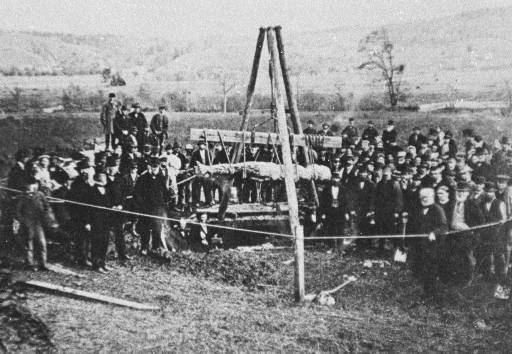
On 16 October 1869, two men digging a well behind a barn in Cardiff, a farming village south of Syracuse, New York, hit something hard. Within minutes they had uncovered a huge stone man lying on his back. Within days thousands of people were paying to see him. The Cardiff Giant became one of the most famous hoaxes in American history, and a carved block of gypsum that fooled a nation.
A quarrel about giants
The giant began with an argument about the Bible. Central New York history site CNY History and Wikipedia both say George Hull, a skeptic, argued with a Methodist preacher who took literally the verse in Genesis about giants on the earth. Hull later said he thought of making a stone man and passing it off as petrified, both to mock literalism and to make money.
Making a giant
History.com and Stephen Jay Gould's 1989 essay in Natural History magazine both describe the next steps. Hull obtained a large block of gypsum at Fort Dodge, Iowa; History.com says he claimed it was for a statue of Abraham Lincoln. He shipped it to Chicago, where stone cutters carved a naked man. Gould writes that Hull chipped off the carved hair and beard, punched the surface with needles to imitate pores and doused it in acid to fake age.
History.com says the giant was shipped to the farm of Hull's relative William 'Stub' Newell and buried near the barn in November 1868. Nearly a year later Newell hired the unsuspecting well-diggers.
Fifty cents a look
Newell put up a tent and charged admission; Gould and CNY History both give fifty cents. Crowds came anyway. Some visitors believed it was a petrified biblical giant; others argued it was an ancient statue. Gould and Wikipedia both say Hull soon sold most of his interest to a group of local businessmen; Wikipedia names David Hannum as their leader and gives the price as $23,000, and the giant moved to Syracuse for exhibition.
Experts call it a humbug
Scientists were not fooled for long. History.com and Gould both quote the Yale paleontologist Othniel C. Marsh, who called it 'of very recent origin, and a most decided humbug'. Wikipedia says he pointed to fresh tool marks on soluble gypsum that should have dissolved in wet soil. Witnesses also remembered a very large box travelling toward Cardiff, Gould notes. In early 1870, History.com says, the Chicago sculptors' confessions appeared in the papers.
Barnum's fake of a fake
The showman P. T. Barnum wanted in. Wikipedia says he offered $50,000 to lease the giant and was refused, so he had a copy made and exhibited it in New York; Gould also says Barnum showed a copy. Barnum's giant drew big crowds, so a fake of a fake competed with the original fake.
This is where a famous line enters the story. The phrase 'There's a sucker born every minute' is usually attributed to Barnum, but Wikipedia says newspapers reported it as said by David Hannum about the people paying to see Barnum's copy. Like many famous quotes, its origin is uncertain.
Where he lies now
After touring and years in storage, the original giant was bought by The Farmers' Museum in Cooperstown, New York. The museum says it has been on exhibit there since 1947, and in 2019 it celebrated the giant's 150th birthday with cake and a party hat.
Further reading
- Stephen Jay Gould, 'The Creation Myths of Cooperstown' (Natural History, 1989)
- History.com: The Cardiff Giant fools the nation
Sources
- https://en.wikipedia.org/wiki/Cardiff_Giant
- https://www.history.com/articles/the-cardiff-giant-fools-the-nation-145-years-ago
- https://naturalhistorymag.com/editors_pick/1989_11_pick.html
- https://www.cnyhistory.org/2014/10/cardiff-giant/
- https://www.farmersmuseum.org/annualreport/2019/highlights/
- https://www.smithsonianmag.com/smart-news/cardiff-giant-was-just-big-hoax-180965274/