The Great Emu War
November 2, 1932
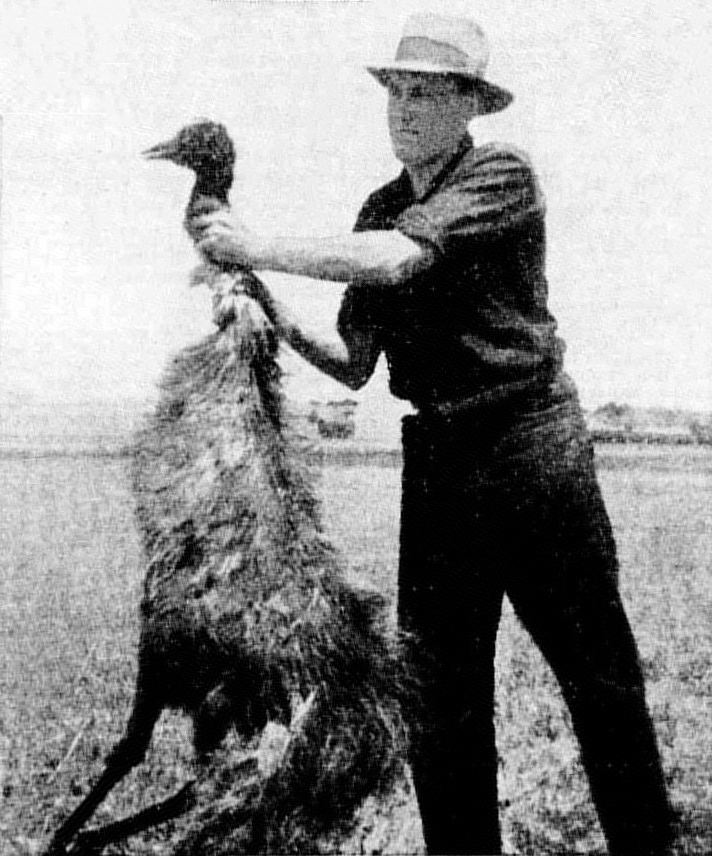
In late 1932 the Australian government sent a small military detachment armed with Lewis machine guns to Western Australia's wheatbelt to deal with an invasion of emus. The birds were not wiped out, the newspapers had a field day, and the episode has been remembered ever since, a little unfairly, as the war Australia lost to a bird.
Soldiers turned farmers
After the First World War, Australia offered land to returning servicemen under soldier settlement schemes, and many took up farms in the dry wheat-growing country of Western Australia. By the early 1930s they were struggling: the Great Depression had pushed wheat prices down and the government's promised support had not arrived as hoped.
Then came the emus. After their breeding season, large numbers of emus migrate toward the coast, and the cleared, watered farmland of the wheatbelt was attractive to them. Historian Murray Johnson, who studied the episode in detail, cites reports of around 20,000 emus in the district in late 1932. They ate and trampled crops and damaged the rabbit-proof fences, letting rabbits in as well.
Calling in the army
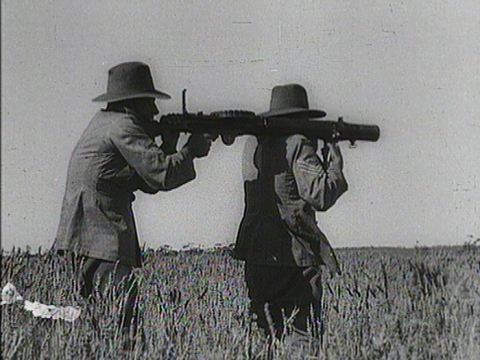
The farmers, many of them ex-soldiers who knew what a machine gun could do, asked the Commonwealth for military help. Defence Minister Sir George Pearce agreed to send a small team. According to the Pickering Brook Heritage Group's account, Pearce reasoned that the birds would make good target practice, and he set conditions: only soldiers would fire the guns, the state government would pay for transport, and the farmers would provide food, accommodation and payment for ammunition.
The force was tiny: Major G. P. W. Meredith of the Seventh Heavy Battery, Royal Australian Artillery, with Sergeant S. McMurray and Gunner J. O'Halloran, two Lewis guns and 10,000 rounds of ammunition. A cinematographer from Fox Movietone went along to film it; HistoryExtra suggests Pearce hoped for good publicity.
The first offensive
Operations began on 2 November 1932 near Campion. They did not go to plan. When the soldiers opened fire on a group of about 50 emus, the birds scattered out of range. On 4 November Meredith set an ambush near a dam as about 1,000 emus came to drink. The gunners waited until the birds were close, but one gun jammed after only about a dozen had been killed, and the rest scattered, according to accounts including an ABC News retrospective and an essay in the journal Frontiers in Ecology and the Environment.
Emus proved fast, tough and good at splitting into small groups. One attempt to mount a gun on a truck failed because the vehicle could not keep up on the rough ground and the gunner could not aim. Newspaper coverage turned mocking, and questions were asked in Parliament. On 8 November the troops were withdrawn. By then, according to ABC News, about 2,500 rounds had been fired, with estimates of birds killed ranging from 300 to 500.
Round two
The farmers' complaints continued, and the soldiers were sent back on 13 November. This time they had more success, and the operation continued into December. When it ended on 10 December, Meredith reported 986 emus killed using 9,860 rounds, about ten bullets per bird, and claimed that many more had been wounded.
Meredith admired his opponents. In a much-quoted remark he compared the emus to tanks, saying that if Australia had a military division with the bullet-carrying capacity of these birds, it would face any army in the world. He went on: 'They could face machine guns with the invulnerability of tanks.' The exact wording of the first part varies between retellings, and the full quotation also included a comparison to Zulu warriors that reflects the racial attitudes of the time.
Why emus were so hard to stop
The soldiers found that emus reacted to gunfire by scattering in all directions into small, fast-moving groups, and observers were surprised at how often wounded birds kept running. Modern Farmer notes they can run at up to about 40 miles per hour.
The terrain did not help. The wheatbelt was a patchwork of open paddocks, scrub and rough tracks. Machine guns are most effective against massed targets that move predictably, and the emus did neither. Rain before the start of operations had already scattered the birds over a wide area, delaying the first engagement until 2 November, which made the task harder still.
Myths and what really happened
The popular version says the emus 'won the war'. In one sense that is fair: the military did not solve the problem, and the campaign was a public-relations embarrassment. But it was a small, short operation by a few soldiers, not a real war, and the army did kill hundreds of birds.
It is also sometimes said that emus were declared enemies or that war was formally declared. Nothing of the kind happened. The term 'Emu War' came from newspaper headlines.
Aftermath
The farmers asked for military help again in later years, including in 1934, 1943 and 1948, according to Johnson, but the government refused. Instead, bounties paid people for killing emus, and they proved far more effective than machine guns: the Frontiers in Ecology essay notes that settlers' rifles took 57,000 birds over a single six-month period in a later year. Barrier fences were also used to keep emus out of farming areas.
Today the emu is a protected native species, appears on Australia's coat of arms, and is listed as Least Concern by the IUCN. The Emu War has become one of the internet's favourite stories, sometimes exaggerated, but rooted in a real and slightly absurd episode.
Further reading
- Murray Johnson, 'Feathered foes: soldiers and emus in Western Australia, 1932', Journal of Australian Studies (2006)
- Trove: 1932 newspaper coverage
Watch the Short
Sources
- https://en.wikipedia.org/wiki/Emu_War
- https://doi.org/10.1080/14443050609388083
- https://nla.gov.au/nla.news-article4509731
- https://nla.gov.au/nla.news-article4504009
- https://pickeringbrookheritagegroup.com.au/miscellaneous/the-emu-war/
- https://www.historyextra.com/period/20th-century/emu-war/
- https://www.abc.net.au/news/2022-12-10/great-emu-war-90-years-on-army-wheatbelt-battle-history/101752238
- https://doi.org/10.1890/1540-9295-11.6.336
- https://modernfarmer.com/2014/04/fought-emus-emus-won/