The Cadaver Synod
897
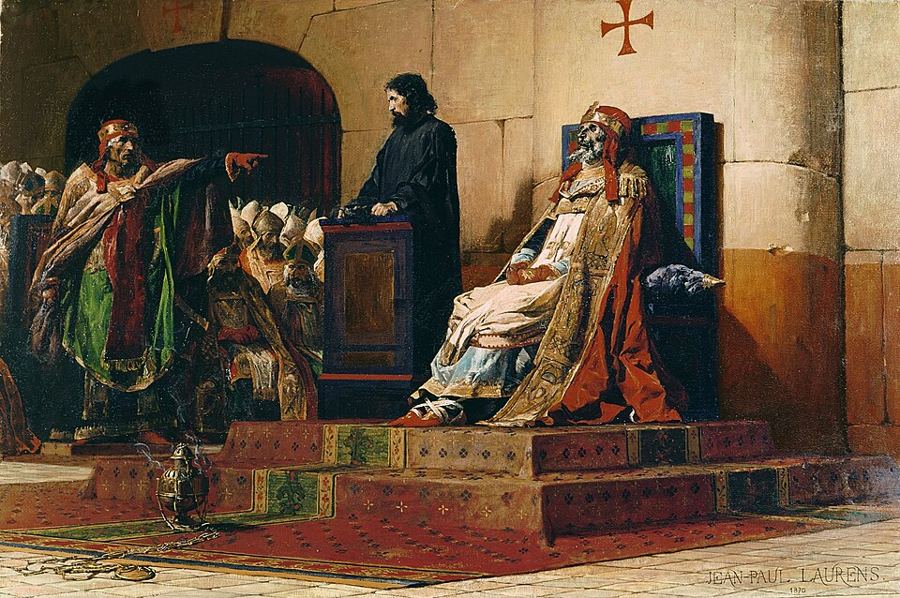
Early in 897, in one of the great churches of Rome, a dead man was put on trial. The defendant was Pope Formosus, who had been buried for months. His corpse was dug up, dressed in papal vestments, propped in a chair and accused of crimes against church law. It was found guilty. The episode, known as the Cadaver Synod, is one of the strangest events in the history of the papacy.
A papacy in chaos
The late ninth century was a terrible time to be pope. National Geographic's history of the episode points out that between 872 and 965 no fewer than 24 popes were crowned in Rome, and between 896 and 904 the city went through roughly one a year. Popes were deposed, imprisoned and in some cases murdered.
Behind the turmoil was a struggle for control of Italy. On one side were the Carolingian emperors, descendants of Charlemagne, who claimed to protect the church. On the other were ambitious local dynasties, above all the Dukes of Spoleto. Rome's own noble families took sides, and the papacy was caught in the middle.
Who was Formosus?
Formosus had a long and controversial career before he became pope. As bishop of Porto, a diocese at the mouth of the Tiber, he carried out diplomatic missions for the papacy to Bulgaria, Constantinople and the Carolingian court. He favoured the Carolingian Arnulf of Carinthia as a check on Spoleto's power.
That made him enemies. In 876 Formosus fled Rome, and a synod under Pope John VIII excommunicated him. He was restored under Pope Marinus I in 883, and in 891 he was elected pope himself. As pope he was forced to recognise Guy of Spoleto as emperor and Guy's son Lambert as his successor, but he quietly invited Arnulf to intervene. In 896 Arnulf took Rome and Formosus crowned him emperor. A few months later Formosus died, at about 80; whether of old age or, as rumour had it, of poison is uncertain.
Lambert's revenge
Formosus's immediate successor, Boniface VI, lasted about 15 days. He was followed by Stephen VI, who had once been a supporter of Formosus. Once Arnulf had left Italy, Stephen switched sides and aligned himself with Lambert of Spoleto.
According to National Geographic's account, Lambert wanted Formosus condemned publicly, to shame his followers, and the plan was for it to be carried out with full legal ceremony before the clergy and the Roman nobility. The most extraordinary part of the plan was that Formosus himself would be present. Historians have suggested the procedure may have drawn on rulings by Pope Gregory the Great in the sixth century about condemning sinners buried in churches.
The trial
Early in 897 Formosus's body was dug up and brought to the Lateran basilica. The proceedings were organised as a formal synod, with cardinals, bishops and other clergy present. The corpse, dressed in papal vestments, was propped up in a chair to face its accusers.
The central charge was that Formosus had become pope illegally, because he was already bishop of Porto and church law at the time was understood to forbid a bishop from moving to another see. The corpse was addressed directly and asked why, as bishop of Porto, it had ambitiously usurped the see of Rome. A deacon was appointed to answer for the dead man; sources say he mostly read prepared statements. The verdict was never in doubt.
The sentence
The synod declared Formosus deposed and condemned, and annulled all his acts, including his ordinations, so the clergy he had ordained had to go through the process again. His body was stripped of its vestments, and the three fingers of the right hand he had used to give blessings were cut off. He was dressed in ordinary clothes and buried in a common grave.
Even that was not the end. Stephen VI had the body dug up again and thrown into the River Tiber.
Backlash
Even for Romans used to violent politics, this went too far. Formosus's supporters turned on Stephen VI, who was arrested, imprisoned and strangled within months of the synod.
A legend says a fisherman later pulled the dead pope's body from the Tiber. National Geographic notes that this part of the story may be a myth. Pope Theodore II, in his brief reign in late 897, had the body reburied in St Peter's in full vestments, and Pope John IX (898) reinstated Formosus and banned any further trials of the dead.
Myths and what really happened
Accounts say Stephen VI personally harangued the corpse; details beyond that are embellishment. Stories that the body performed miracles after it was pulled from the river belong, like the fisherman, to legend rather than solid record. What is well established is the core of the story: the exhumation, the trial before a synod, the guilty verdict, the mutilation and the disposal of the body in the Tiber, and Stephen's violent end.
The episode was also not quite the end of the quarrel. The validity of Formosus's acts continued to be fought over by his successors for years, a sign of how bitterly divided Rome was.
Legacy
The Cadaver Synod has become a byword for the depths the medieval papacy could sink to during what historians sometimes call its darkest age. It inspired the French painter Jean-Paul Laurens, whose 1870 painting of the trial, showing the slumped corpse in its robes facing Stephen VI, is the image most people now associate with the story.
Further reading
As posted on X: read the Stranger Than History thread