The Aurora, Texas Airship Crash
April 17, 1897
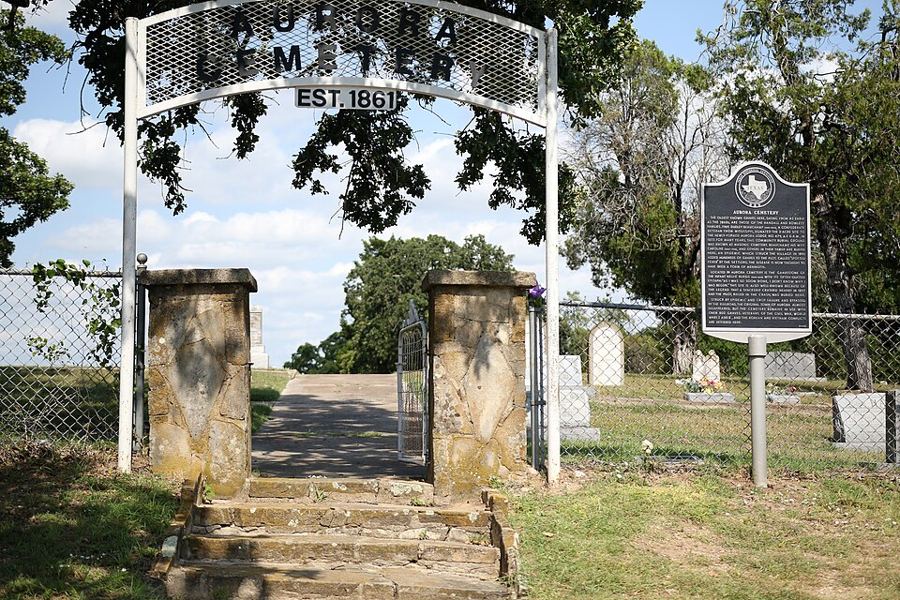
On 19 April 1897 the Dallas Morning News printed a short dispatch from the little town of Aurora in Wise County, Texas. An airship, it said, had crashed into a judge's windmill at dawn and exploded, and the remains of its pilot showed he 'was not an inhabitant of this world'. The story has been called Texas's Roswell. Historians call it a hoax.
What people reported
The dispatch, dated Aurora, 17 April, and signed S. E. Haydon, appeared on page 5 of the Dallas Morning News on 19 April 1897. It said that at about 6 o'clock that morning the early risers of Aurora had been astonished by the sudden appearance of 'the airship which has been sailing through the country'. It was flying north, lower than ever before, at only ten or twelve miles an hour, and seemed to be having mechanical trouble.
According to the story, the ship passed over the public square and, at the north end of town, hit the tower of Judge Proctor's windmill and 'went to pieces with a terrific explosion', scattering debris over several acres and wrecking the windmill, the water tank and the judge's flower garden. The pilot, apparently the only person on board, was badly disfigured, but 'enough of the original has been picked up to show that he was not an inhabitant of this world'. A Mr T. J. Weems, described as the US Signal Service officer and an authority on astronomy, gave his opinion that the pilot was a native of Mars.
Papers found on the body, the dispatch said, were written in unknown hieroglyphics. The ship was built of an unknown metal resembling a mix of aluminium and silver and must have weighed several tons. The town was full of people viewing the wreck and collecting pieces of the strange metal. The pilot's funeral, Haydon wrote, would take place at noon the next day.
The story did not come from nowhere. As the Texas Almanac describes, in April 1897 newspapers reported airship sightings from more than 20 Texas counties, mostly in North Central Texas, part of a wider wave across the United States. Witnesses typically described cigar-shaped craft with propellers, wings and searchlights, and some papers printed tall tales of conversations with their crews.
What investigators found
The Texas State Historical Association calls Haydon's piece a fictional news story. Haydon, it notes, was a cotton buyer in Aurora, a town that had been declining since a spotted fever outbreak in 1888 and 1889, and which lost most of its remaining people after the railroad abandoned plans to come through in favour of nearby Rhome. The story caused a sensation because tales of airships near Fort Worth were already circulating, but it did nothing for the town: Aurora lost its post office in 1901. The Texas Almanac says the Aurora incident has been labelled a hoax by 20th-century historians.
Local memory points the same way. In 1979 Time magazine interviewed Etta Pegues, then 86, who said Haydon 'wrote it as a joke and to bring interest to Aurora. The railroad bypassed us, and the town was dying.' According to Fort Worth Magazine's account of the interview, she also said Judge Proctor never had a windmill. That detail has been argued over since: a television UFO programme later reported finding a well and possible pump base on the old Proctor land, while other investigators have argued the well dates from the 20th century.
Interest revived in the 1970s, when UFO researchers, including the Mutual UFO Network, visited Aurora, interviewed elderly residents and searched the cemetery for the pilot's grave. Fort Worth Magazine reports that a gravestone said to mark the alien's burial went missing, and that the cemetery's stewards refused permission for any exhumation. No wreckage, body or other physical evidence has ever been confirmed.
Today a Texas Historical Commission marker outside the Aurora Cemetery is the nearest thing to a monument to the story. The story inspired a 1986 film, The Aurora Encounter. The verdict of historians is that it was a tall tale written at the height of the airship craze, and that the only thing that ever crashed in Aurora was a newspaper hoax.
Further reading
- Texas State Historical Association: Author attempts to jump-start town with fictional UFO story
- Texas Almanac: When airships invaded Texas