The Leatherman's Endless Walk
March 24, 1889
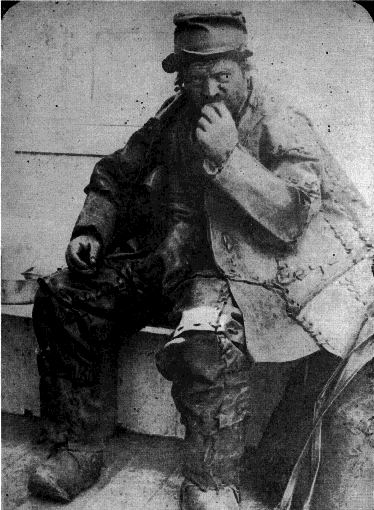
For about three decades in the late 19th century, a silent man in a suit stitched together from scraps of leather walked the same 365-mile loop through western Connecticut and eastern New York. He came back to each town roughly every 34 days, so regularly that families set food out for him. He slept in caves, spoke almost no English, and never told anyone who he was. More than a century after his death, nobody knows.
The man in leather
He was called the Leatherman, or the Old Leather Man, because his hat, clothes and shoes were all handmade from leather. Photographs taken in the 1880s, now held by the Connecticut Museum of Culture and History, clearly show the heavy patchwork suit. According to the folklorist Michael Hoberman, writing for Connecticut History, he spent a good deal of time patching and repairing it, so it changed with every piece he added.
His first recorded appearance in Connecticut, Hoberman notes, was in Harwinton in 1858; other accounts date the start of his circuit to about 1857. An 1870 article in the Burlington Free Press called him the 'Leather-Clad Man' and said he spoke rarely, in monosyllables.
The 365-mile loop
From his first appearance until the end of his life, the Leatherman walked a clockwise loop of about 365 miles that took about 34 days. It passed through Connecticut towns such as Danbury, New Fairfield, Watertown, Middletown and New Canaan, crossed into Westchester County, New York, and came back again. He kept to it through blizzards and every other kind of weather.
His regularity made him part of the calendar. People along the route knew when he was due and had food ready, which he often ate on their doorsteps. One store kept a record of an order he placed: a loaf of bread, a can of sardines, a pound of fancy crackers, a pie, two quarts of coffee, a gill of brandy and a bottle of beer. How he got his money is unknown.
Caves and silence
Though he was offered beds in houses and barns, he preferred to sleep in caves and rock shelters, which he heated with fires. Several are still known locally as Leatherman caves. His face was sometimes frostbitten, but, unlike many tramps of the period, he never lost fingers to the cold.
He communicated mostly with grunts and gestures, and his English was broken, but he was fluent in French. If people asked about his past, he ended the conversation, and, Hoberman writes, those who were too curious found he stopped coming to their homes. Those who helped him on his own terms were rewarded with his regular return and silent thanks. Hoberman relays a story from the folklorist David E. Philips about a Bristol teacher who encouraged her pupils to work hard by letting the best of them serve the Leatherman as a reward.
Connecticut passed a law against tramps in 1879. Ten towns along his route passed ordinances exempting him from it.
Illness and death
In 1888 the Connecticut Humane Society had him arrested and taken to hospital. He was diagnosed as 'sane except for an emotional affliction' and released, since he had money and wanted his freedom. Hoberman notes that the hospital stay only set him back a few days on his rounds.
He had cancer of the mouth. He was found dead on 24 March 1889, in a cave in the Saw Mill Woods on a farm in Mount Pleasant, New York, near Ossining. A French prayer book was found among his possessions. Local people buried him in the paupers' section of Sparta Cemetery.
Who was he?
The most famous answer is that he was Jules Bourglay of Lyons, France. In this story, which circulated in the press during his lifetime, he was the disgraced suitor of a leather merchant's daughter who had ruined her family's business and fled to America to do silent penance. His old tombstone even carried the name. Connecticut History describes the tale as debunked.
According to the researcher Dan W. DeLuca, co-author of The Old Leather Man (Wesleyan University Press, 2008), the name first appeared in the Waterbury Daily American in 1884, and the paper retracted it after his death in 1889. His New York death certificate leaves his identity unknown. He declined meat on Fridays, which led people to think he was Catholic, and he was widely assumed to be French or French-Canadian. Beyond that, nobody knows.
The empty grave
His grave was close to a busy road, Route 9, and in 2011 it was moved to a safer spot in the cemetery. Researchers hoped the exhumation would yield remains that could reveal his origins, perhaps through DNA. Nothing was left but a few coffin nails. Those and the soil from the original grave were reburied under a simple new marker that reads only: The Leatherman.
Legacy
The Leatherman has become one of the best-loved legends of Connecticut and the Hudson Valley. People still trade stories about which caves his ghost haunts and where he might have hidden his money. His real achievement is easier to measure: decades of walking the same loop, in all weather, sustained by the kindness of strangers who never learned his name.
Further reading
As posted on X: read the Stranger Than History thread