The Carrington Event
September 1, 1859
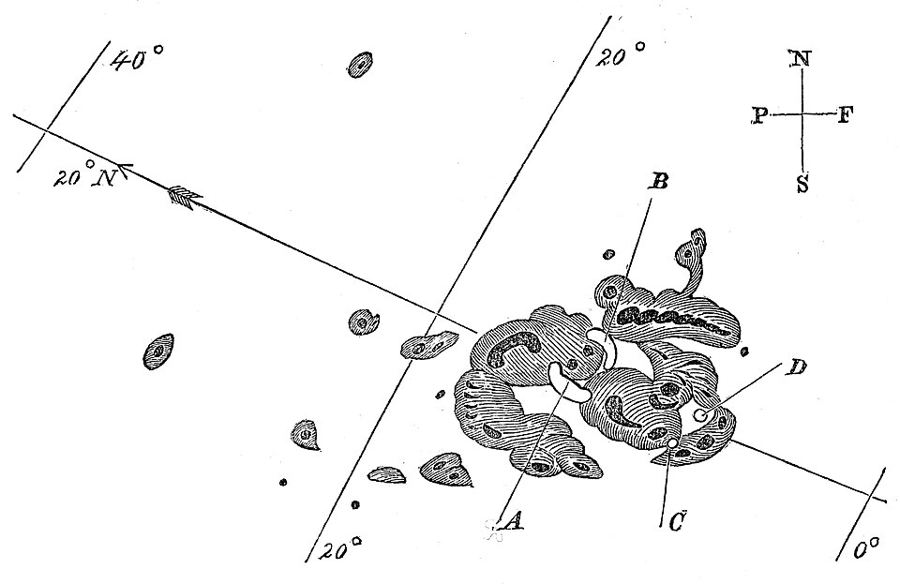
Just before noon on 1 September 1859, British astronomer Richard Carrington was sketching a huge group of sunspots when two brilliant beads of white light flared across his projection of the Sun. About seventeen hours later Earth was hit by what is still often called the most intense geomagnetic storm in recorded history. Auroras shone as far south as the Caribbean and Hawaii, telegraph wires sparked and shocked operators, and for a short stretch of line in New England messages ran with the batteries disconnected, powered by the storm itself.
A white-light flare
Carrington was working at his private observatory at Redhill when the flare appeared over the sunspot group he was drawing. He timed it at a few minutes and later published a sketch and account in Monthly Notices of the Royal Astronomical Society. Richard Hodgson, observing independently, published a matching note in the same issue. Their reports are treated as the first published records of a solar flare.
A magnetometer at Kew Observatory recorded a simultaneous disturbance, what later space-weather scientists call a solar flare effect or magnetic crochet. Carrington suspected a link between the flash and the geomagnetic storm that followed, but he was careful not to overclaim. Scientific American later summarised his caution with the proverb he used: one swallow does not make a summer.
Two storms, not one
What people call the Carrington Event was really a cluster of disturbances. A major aurora and telegraph disruption had already hit on 28–29 August. The September flare and the storm that peaked on 2 September arrived on the heels of that earlier blast. NASA scientists James Green and Scott Boardsen, reconstructing eyewitness reports, treat the late-August and early-September displays as two closely spaced worldwide auroral events, with the September storm the one tied to Carrington and Hodgson’s white-light flare.
Modern reconstructions, including a widely cited Scientific American account by Sten Odenwald and James Green, argue that an earlier coronal mass ejection had partly cleared the path, so the September cloud crossed the Sun–Earth distance in roughly seventeen hours instead of the several days a typical CME needs. Wikipedia, summarising the same research tradition, gives an estimated travel time of about 17.6 hours.
Auroras near the tropics
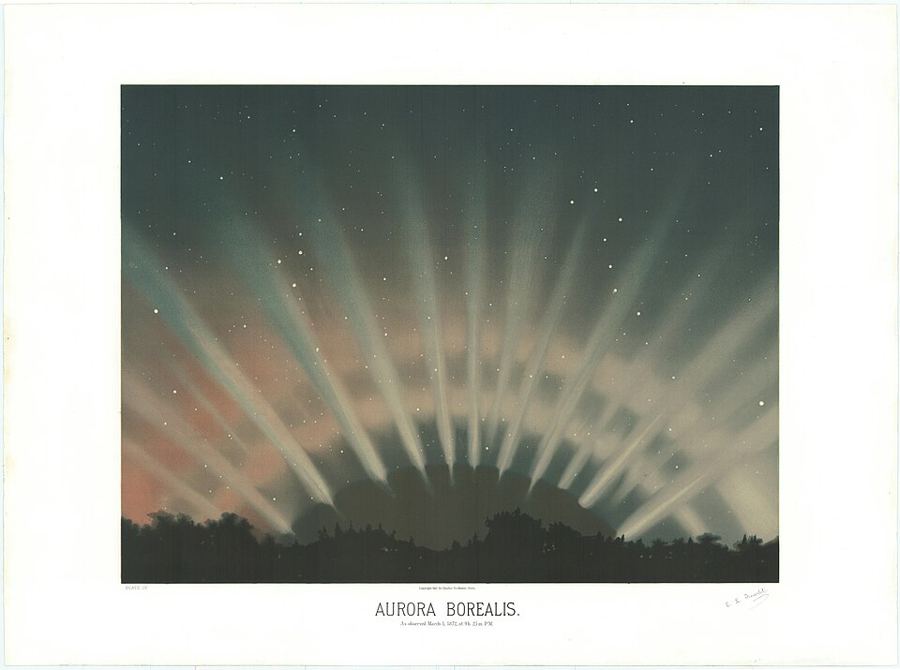
When the storm hit, auroras were reported far outside their usual high-latitude homes. Green and Boardsen, drawing on newspapers, ship logs and scientific journals, describe blood-red Type A aurora so bright that people said they could read a newspaper by it. They map auroral forms below 50 degrees geomagnetic latitude for roughly a day on 28–29 August and for about forty-two hours on 2–3 September, with the September peak reaching extremely low geomagnetic latitudes.
Contemporary and later compilations place sightings in Cuba, Hawaii, parts of Mexico, Queensland, southern Japan and China, New Zealand and even reports near the equator in Colombia. Scientific American repeats a much-told Rocky Mountain story: gold miners woken by the glow and preparing breakfast because they thought dawn had come. We keep that as a reported anecdote; the underlying point, dual-sourced in Green and Boardsen and in Odenwald and Green, is that the light was bright enough at mid-latitudes to be mistaken for morning.
Telegraphs on celestial current
Telegraph networks across Europe and North America were the high technology of 1859, and they took the hit. Operators reported shocks, sparking equipment and, in some accounts, paper set alight. Green and Boardsen note that a significant share of the world’s telegraph mileage was disrupted, with many lines unusable for eight hours or more.
The strangest detail is well documented. On the American line between Boston and Portland, operators disconnected their batteries and kept working on the current induced by the aurora. Elias Loomis collected the exchange in the American Journal of Science: Boston asked Portland to cut its battery; both ends worked for about two hours on auroral current alone, with Portland reporting the writing came through better than with batteries. That conversation is also summarised in Wikipedia and in later NASA-linked reviews of the eyewitness record.
Myth versus measurement
Popular retellings sometimes treat Carrington as if he alone discovered space weather overnight. In reality he and Hodgson recorded the flare; Balfour Stewart and others logged the magnetic crochet; Loomis and many newspapers compiled the aurora and telegraph reports; and only later did the solar–terrestrial link become consensus. Scientific American notes that the October 1859 press was already arguing that auroras, electricity and magnetism were connected.
Another trap is calling it simply the biggest storm ever without saying on what measure. It is routinely described as the most intense geomagnetic storm in the instrumental record, but estimated storm-strength numbers still span a range, and ice-core nitrate spikes once offered as a Carrington fingerprint are now widely doubted. Green and Boardsen still call it arguably the greatest space-weather event of the past two hundred years; we follow that careful framing rather than a single Dst number.
Why it still matters
A Carrington-class storm today would not merely light the sky. Odenwald and Green warned that satellites, radio links and power grids would be at risk; the US National Research Council’s 2008 workshop report on severe space weather made the same point for a modern technological society. NASA has also highlighted a July 2012 coronal mass ejection of comparable strength that narrowly missed Earth.
None of that turns 1859 into prophecy. It does explain why Carrington’s five-minute flash is still the reference event for space-weather planners, and why the Boston–Portland operators working by auroral current remain the emblem of how strange, and how practical, the storm’s effects were.
Further reading
- Green & Boardsen: Duration and extent of the great auroral storm of 1859 (PMC)
- Scientific American: Bracing for a Solar Superstorm (Odenwald & Green)
- NASA NTRS: Eyewitness reports of the great auroral storm of 1859
- Carrington 1859, Monthly Notices of the RAS