The Photographer Who Got Away with Murder
October 17, 1874
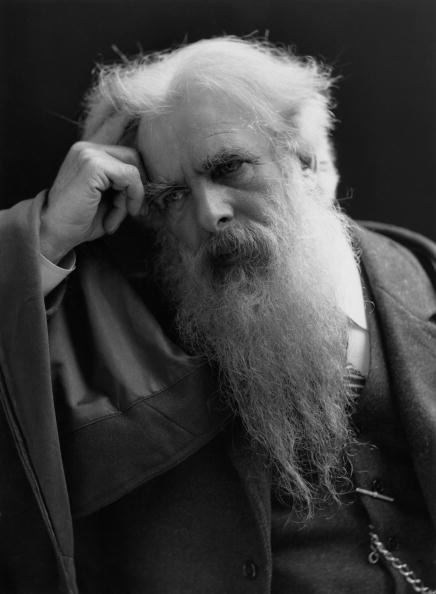
Eadweard Muybridge is remembered as the photographer who proved that a galloping horse lifts all four hooves off the ground, and whose sequences of moving animals and people helped lead to cinema. Before any of that, in October 1874, he tracked down his wife's lover at a mining camp in California's Napa County and shot him dead. A jury let him go.
Edward Muggeridge
He was born Edward James Muggeridge in England in 1830. According to the Los Angeles Times, he took the name Eadweard Muybridge, which he claimed was its original Anglo-Saxon form, and moved to the United States as a young man, opening a bookstore in San Francisco in 1856. In the late 1850s he took up photography, recording San Francisco and the landscapes of Yosemite.
In 1860 he was badly hurt when the Butterfield Overland stagecoach he was travelling on crashed in Texas. Friends later testified that the head injury changed his personality, from genial and pleasant to unstable and erratic. The Christian Science Monitor, citing Stanford Magazine, notes that he was known for risky deeds and emotional explosions.
A marriage and an affair
In the early 1870s Muybridge, then in his early forties, married Flora Stone, a 21-year-old divorcee who, the Los Angeles Times says, worked as a photo retoucher; sources give the year as 1871 or 1872. Their tastes differed widely. She went to the theatre and other entertainments, often without him, and he was often away for weeks or months on photographic assignments, including documenting the Modoc War for the U.S. Army.
Flora became involved with Harry Larkyns, a drama critic and friend of the couple. Muybridge warned Larkyns off, and believed the affair was over when Larkyns took a job at a mine near Calistoga. In April 1874 Flora gave birth to a son, Florado Helios Muybridge.
The discovery
In mid-October 1874 Muybridge learned how serious the affair still was. Flora's maternity nurse told him the details and had love letters the couple had been exchanging. He also found a photograph of the baby with 'Harry' written on the back in Flora's handwriting; the Christian Science Monitor, citing Stanford Magazine, says the caption read 'Little Harry'. Muybridge came to doubt that the boy was his.
The shooting
On 17 October 1874 Muybridge travelled to Calistoga and on to the place near the mine where Larkyns was staying; the Los Angeles Times says Larkyns was playing cribbage in a cabin. Muybridge called him to the door. According to the usual account, he said, 'I have a message for you from my wife,' and shot him at point-blank range, through the heart. Larkyns died that night.
Muybridge did not run. He waited to be arrested and was taken to the jail in Napa. A Sacramento Daily Union reporter who visited him found him in moderately good spirits and hopeful.
The trial
Muybridge spent about four months in jail before his trial for murder in February 1875. His defence was arranged by the railroad magnate and former governor Leland Stanford, who had hired him to photograph his horses. The lawyers first argued insanity, pointing to the stagecoach injury, and at least four old acquaintances testified that he had changed after the crash. But Muybridge undercut that defence himself by making clear that he had acted deliberately.
The defence switched to justifiable homicide. The Los Angeles Times quotes his lawyer W. W. Pendegast telling the all-male jury that it was the weakness of the law that there was no adequate punishment for the seducer, and urging them to acquit if they loved virtue, good women, home and friends. After deliberating for about 13 hours, the jury did. They explained that if their verdict was not in accordance with the law, it was in accordance with the law of human nature. Muybridge reportedly sobbed with relief.
Aftermath
Shortly after the trial Muybridge left on a long photographic trip to Central America, a kind of working exile. Flora, who had filed for divorce, died suddenly in July 1875 at the age of 24, while he was away. Their son had been placed with a French couple, and Muybridge later moved him to an orphanage and paid for his care, but had little to do with him. Photographs of Florado as an adult show a strong resemblance to Muybridge. He worked as a ranch hand and died in 1944.
Horses in motion
By 1877 Muybridge was working for Stanford again. In 1878, at Stanford's Palo Alto farm, he set up a row of 12 evenly spaced cameras triggered as a horse ran past, and captured the horse Sallie Gardner with all four feet off the ground. He went on to show his sequences with a projecting device he called the zoopraxiscope, which the Hollywood historian Marc Wanamaker told the Los Angeles Times was the forerunner of the motion picture projector. Later work at the University of Pennsylvania produced an 11-volume study of human and animal movement. He died in England in 1904.
Myths and what really happened
The 'message from my wife' line is the standard version of what Muybridge said, but it comes from trial testimony and retellings, and wording varies. Contemporary sources disagree on small facts, such as the year of the marriage and the spelling of his son's name. What is clear is that he killed Larkyns deliberately, admitted it, and was acquitted by a jury that sympathised with a betrayed husband. As the Christian Science Monitor put it, he was a man who got away with murder.
Further reading
- Los Angeles Times: Photo pioneer shot more than just pictures (2006)
- Christian Science Monitor: Did Eadweard J. Muybridge get away with murder?
As posted on X: read the Stranger Than History thread